Why Older Adults Are Now a Fitness Priority
Why Older Adults Are Now a Fitness Priority
Walk the floor of any gym at nine on a Tuesday morning and count the gray hair. That’s not a sign of decline in the industry. That’s the market.
For most of my career, “fitness” was designed around a twenty-five-year-old’s body and a twenty-five-year-old’s schedule. Equipment, class formats, even the language on gym walls, all built for people chasing aesthetics or a personal best. Older adults were an afterthought, tucked into a corner with the resistance bands and told to “take it easy.” I spent years watching that assumption cost people their independence. It’s finally changing, and not because the industry had a change of heart. The numbers forced it.
1. The Math Nobody Talks About
Here’s the part that gets skipped in most coverage of this shift: it’s not really a health story first, it’s a demographic one. People over 55 are the fastest-growing segment of gym membership in several major markets, and they’re not just showing up, they’re staying. Retention rates for adults over 60 tend to outperform the 18-to-34 group by a wide margin once they get through the first three months.
That matters to a facility owner in a very direct way. A twenty-something might churn after eight weeks because a new hobby or a relationship or a job change pulled their attention elsewhere. A sixty-eight-year-old who joined to protect her ability to lift her grandson or get off the floor without help has a reason that doesn’t go away. Facilities noticed. Equipment manufacturers noticed. That’s why you’re seeing more low step-up platforms, more adjustable-load machines, more programming built around balance and grip strength instead of just aesthetics.
This is also, frankly, where the money moved. Older adults have more disposable income on average than the twenty-something demographic the industry spent decades chasing, and they spend it on things that keep them functional. Personal training packages, recovery tools, supervised small-group classes. The fitness industry is a business before it’s anything else, and businesses follow spending.
2. What Actually Changes in the Body After 50
None of this works, though, if the training doesn’t match what’s actually happening physiologically, and this is where a lot of well-meaning advice falls apart.
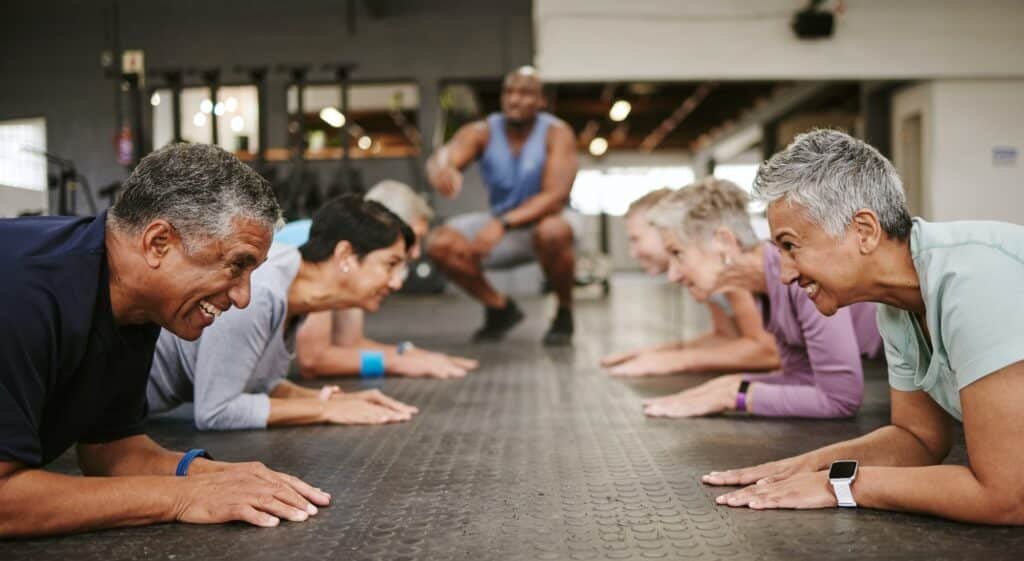
Muscle mass declines gradually starting in the thirties and the rate accelerates after sixty, a process called sarcopenia. Left unaddressed, it doesn’t just mean weaker arms. It means a slower walking pace, worse balance, a harder time recovering from a fall, and in the worst cases, a loss of the ability to live independently. Bone density follows a similar arc, particularly for women after menopause. And the nervous system’s ability to fire muscles quickly, which matters enormously for catching yourself when you trip, declines faster than strength itself does.
Here’s a rough sense of what tends to shift and when:
| Decade | What Typically Changes | What Helps Most |
|---|---|---|
| 40s | Recovery slows, muscle mass begins declining | Consistent resistance training, 2x/week minimum |
| 50s | Bone density drops (especially post-menopause) | Load-bearing exercise, protein intake, balance drills |
| 60s | Power and reaction speed decline faster than raw strength | Explosive movements at low load, single-leg work |
| 70s+ | Fall risk becomes the dominant health threat | Balance-specific training, grip strength, gait practice |
None of this is a reason to slow down. It’s a reason to train differently than a person half your age would, with more attention to the movements that actually protect daily function.
3. Where People Usually Get It Wrong
The most common mistake I see, and I mean this is the one that shows up over and over across every gym I’ve ever walked into, is the assumption that older adults should train gently. Light weights, lots of rest, cardio-first. It comes from a good place. It’s also backward.
Strength training is the single intervention with the strongest evidence behind it for preserving independence with age, and it needs real load to work. A seventy-year-old doing bicep curls with two-pound dumbbells isn’t protecting her joints, she’s under-stimulating the exact tissue she needs to preserve. The body doesn’t respond to being handled carefully. It responds to being asked to do something slightly harder than it’s used to, with enough recovery in between to adapt.
The fix isn’t reckless loading either. It’s supervised, progressive, and built around movement patterns that transfer to real life: getting up off a chair, carrying groceries, catching your balance on uneven ground. That’s a different training philosophy than “go easy,” and it’s one more coaches are finally being trained to deliver.
4. What Actually Works, In Practice
A few things show up consistently in programs that get real results with older clients, and none of them are complicated.
Resistance training two to three times a week, with enough load that the last few reps of a set are genuinely hard. Protein intake spread across the day rather than loaded into one meal, since older adults absorb and use dietary protein less efficiently than younger adults do, meaning the target often needs to be higher than people expect. Fitness Updates has covered how much protein you actually need daily in more detail, and it’s worth a look if you’re building a plan around this.
Balance work belongs in every session, not as a warm-up afterthought but as its own line item. Single-leg stands, controlled step-downs, anything that challenges stability under load. And recovery matters more here than at any other stage of life. A missed rest day doesn’t just mean soreness, it can mean a setback that takes weeks to recover from instead of days.
Wearable technology has actually made a real difference in this specific population, more than I expected when the trend started. Heart rate and recovery tracking give older clients and their coaches an honest read on how hard is too hard, which matters when the cost of overtraining is a joint injury rather than a missed PR. We wrote about why wearable trackers are reshaping workouts if you want the fuller picture on that shift.
And activity outside the gym counts more than people give it credit for. This is part of why pickleball has taken off among busy and older adults, it delivers balance work, reaction training, and social connection in one low-barrier package. The social piece isn’t a soft add-on either. Isolation is one of the strongest predictors of decline in older adults, right up there with the physical factors.
5. The Bigger Picture
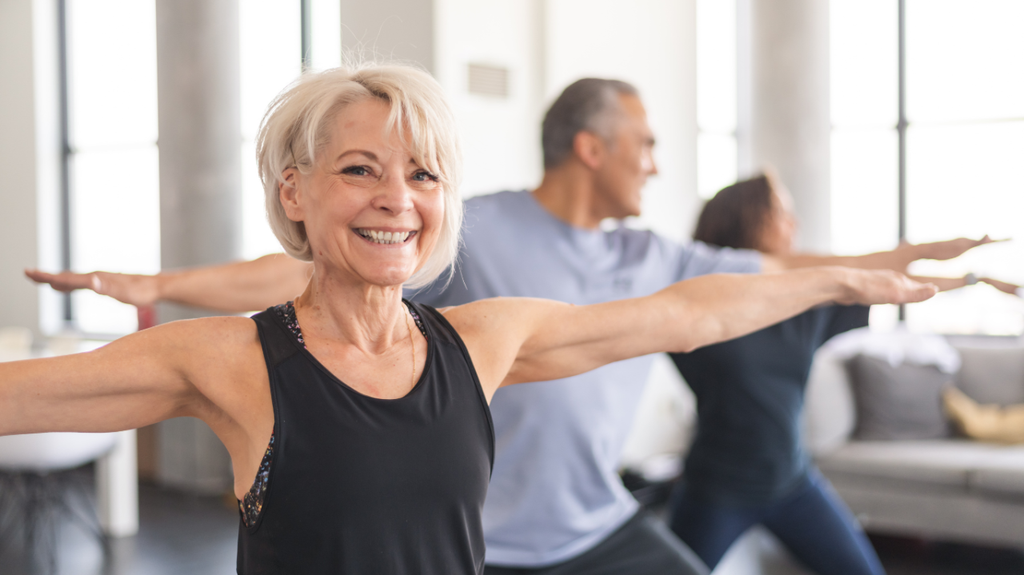
Longevity research keeps circling back to a similar theme: the places where people live the longest, healthiest lives tend to build movement into daily life by default rather than treating it as a scheduled task. Fitness Updates broke this down in the piece on what Blue Zones can teach us about movement and longevity, and it lines up with what I’ve seen firsthand. The people I’ve watched age best weren’t the ones with the most disciplined gym routines. They were the ones who never really separated “exercise” from “life” in the first place. Gardening, walking to get groceries, playing with grandkids on the floor. The gym supplements that. It doesn’t replace it.
That’s really the shift happening in the industry right now. Older adults aren’t a niche market anymore, and they’re not being handed a watered-down version of real training either. They’re getting programs built specifically for what their bodies need at this stage, and the results are showing up in how long people stay capable, not just how long they live.
FAQs
Is it too late to start strength training in your 60s or 70s? No. Muscle tissue remains responsive to resistance training well into your eighties and beyond. The adaptation curve is slower than it would be for a younger adult, but it’s very real, and even modest strength gains translate to meaningful improvements in daily function.
How much cardio should older adults actually be doing? Somewhere around 150 minutes a week of moderate activity is the commonly cited target, but the bigger mistake is treating cardio as the priority and strength training as optional. For this age group, it should generally be the other way around.
Are bodyweight exercises enough, or is external load necessary? Bodyweight work is a fine starting point, especially for balance and mobility. But for building or preserving muscle and bone density, external load, whether that’s dumbbells, resistance bands, or machines, becomes necessary fairly quickly as the body adapts.
What’s the single biggest predictor of who stays independent longer? Grip strength and the ability to rise from a seated position unassisted are two of the most reliable markers researchers keep coming back to. Both are trainable, and both respond well to consistent resistance work.
Should older adults train differently after an injury than younger people would? Recovery timelines tend to be longer, and the return-to-load progression usually needs to be more gradual. That doesn’t mean less training long-term, just a more patient path back to it, ideally with a coach who has specific experience working with older clients.
If you want to go deeper on the equipment side of this shift, Escape Fitness has been building functional training tools around exactly this population for years, and it’s worth a look at what’s changed in gym floor design as a result.