What Blue Zones Can Teach Us About Movement and Longevity

What Blue Zones Can Teach Us About Movement and Longevity
Most of what gets said about Blue Zones in the fitness world is wrong, or at least incomplete. People hear “the places where everyone lives to 100” and immediately think diet: olive oil, wine in moderation, beans instead of red meat. The food matters. But after nearly three decades spent building gym floors and watching how people actually move through their day, the thing that stands out to me about Sardinia, Okinawa, Nicoya, Ikaria and Loma Linda isn’t what’s on their plates. It’s what’s almost entirely absent from their lives: structured exercise.
That’s not a throwaway line. None of the five original Blue Zones have anything resembling a fitness culture the way we’d recognize it. No gym memberships. No step-count competitions. No leg day. And yet these are the regions researchers keep pointing to when they study people who reach 90 and 100 while staying mobile, independent and mentally sharp. There’s a lesson in that gap, and it’s one I think the fitness industry, including plenty of people at Escape Fitness, has been slow to fully absorb.
1. What Blue Zones Actually Are, and Aren’t
The term comes from demographer Michel Poulain and researcher Gianni Pes, who were mapping unusually high concentrations of centenarians in Sardinia and literally drew blue circles around the villages with the highest longevity rates on a map. Dan Buettner later expanded the concept into a broader research project covering five regions worldwide, each with its own culture, diet and daily rhythm, but with a set of overlapping habits.
The movement habit is the one that gets flattened into a soundbite (“they just walk a lot”) when the reality is more specific. Sardinian shepherds cover several miles of uneven, hilly terrain most days, not on a treadmill but tending animals. Okinawan gardeners spend hours a day in a low squat, tending vegetable plots, which is functionally a sustained mobility and hip-strength practice most gym members would find brutal if you asked them to do it deliberately. Nicoyans in Costa Rica do physical labor well into their 80s because the work is woven into the household, not because anyone told them it was good for their VO2 max.
None of this is exercise in the sense we use the word. It’s movement that has a purpose attached to it that isn’t “get fit.” That distinction turns out to matter more than most training programs give it credit for.
2. The Movement Pattern the Gym Floor Rarely Talks About
Here’s where people usually go wrong: they hear about Blue Zone movement and try to replicate it with a fitness solution, like adding a daily walk to an already packed schedule and treating it as a box to check. It helps, genuinely, but it misses the mechanism. What actually separates Blue Zone movement from a scheduled workout is frequency without intensity spikes and, critically, that it never fully stops. There’s no “workout” that ends and a sedentary block that follows. Movement is distributed across the entire waking day in small, low-grade doses.
This is sometimes called Non-Exercise Activity Thermogenesis, or NEAT, in physiology circles, and it accounts for a much larger share of daily energy expenditure than most people assume, often more than a single hour at the gym. But NEAT research only captures the calorie side. The Blue Zone pattern also keeps joints moving through fuller ranges of motion repeatedly throughout the day rather than in one concentrated session, and that seems to be part of why mobility holds up so much longer in these populations.
If you’ve read our piece on why muscle soreness sometimes peaks two days later, you already understand part of why this matters. Concentrated, infrequent effort creates more tissue stress and a longer recovery debt than the same total workload spread across a week. Blue Zone movement almost never creates that debt because it’s never concentrated enough to.
3. Where This Gets Misapplied in a Modern Gym Setting
The mistake I see most often, both from beginners and from people who’ve been training for years, is treating “Blue Zone lifestyle” as permission to drop structured strength work entirely. That’s a misreading of the research, and it’s a costly one past a certain age.
Blue Zone populations maintain lean mass largely through load-bearing daily labor, carrying water, working land, climbing hills. Most of us don’t have that built into a normal week anymore. Remove structured resistance training from a modern, largely sedentary life and you lose the loading stimulus that daily labor used to provide, without gaining anything back. This is one of the reasons we’ve written before about why new gym goers quit so fast and about the workout mistakes that slow beginner progress: people either overcorrect into a training style that’s too intense to sustain, or they swing the other way and assume “just move more” replaces loading altogether. Neither works long term.
The honest takeaway is that Blue Zone movement and structured strength training aren’t competing approaches. One replaces work that used to happen automatically. The other builds and preserves the muscle and bone density that keeps a person independent at 85, which is a different physiological problem that daily walking alone doesn’t solve.
4. What a Blue Zone Movement Pattern Looks Like at Fitness Updates
Quick reference, because this gets asked constantly and the specifics matter more than the general idea:
| Blue Zone | Primary Daily Movement | What It Replicates at Home |
|---|---|---|
| Sardinia, Italy | Hillside shepherding, uneven terrain walking | Incline walking, farmer’s carries on varied ground |
| Okinawa, Japan | Sustained low squatting, gardening | Deep squat holds, floor-sitting mobility work |
| Nicoya, Costa Rica | Manual household and farm labor | Loaded carries, functional pushing and pulling |
| Ikaria, Greece | Steep terrain walking, gardening | Stair or hill intervals, hip-hinge gardening tasks |
| Loma Linda, USA | Regular walking, community-based activity | Group walks, structured but social movement sessions |
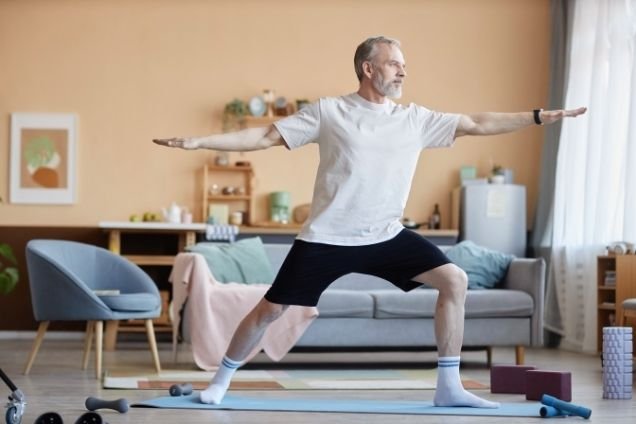
None of this requires a gym membership. It requires building movement back into the shape of a normal day, which is a big part of why we keep coming back to the home workouts versus gym training question on this site. For a lot of people, especially past 50, the honest answer is a mix: a couple of loaded strength sessions a week, plus movement stitched into daily errands, chores and social time, rather than one long structured block and eight sedentary hours around it.
And this is where community matters more than people expect. Ikarians and Sardinians rarely move alone. They move because they’re doing something with someone else, tending land together, walking to visit family, working alongside neighbors. That social layer keeps the habit sticky in a way that a solo treadmill session usually doesn’t. It’s part of why activities like the ones covered in why pickleball is beating the gym for busy adults tend to have staying power that a New Year’s resolution gym membership rarely does.

5. Building This Into a Life That Doesn’t Have Time For It
Nobody reading this is about to move to a Sardinian hillside. So the practical version looks something like this:
- Replace one short car trip a week with a walk, even if it takes longer.
- Add a loaded carry or two into your week, groceries count, a weighted backpack on a walk counts.
- Spend a few minutes a day in a deep squat or on the floor, not as a stretch, just as a resting position.
- Keep one strength session that’s non-negotiable, even a short one, because daily NEAT doesn’t replace progressive loading.
- Find one recurring activity that’s social by default, a walking group, a sport, a standing weekly plan with a friend.
None of these are dramatic. That’s the point. Blue Zone longevity isn’t built on heroic effort, it’s built on movement that’s boring enough to repeat for sixty years without quitting. If you’re just getting started and want a structured starting point rather than piecing this together yourself, our beginner routine without gym equipment guide is a reasonable place to begin.
FAQs
Do I need to move for hours a day to get any Blue Zone-style benefit? No. The research points to frequency and consistency over decades, not duration on any single day. Ten to twenty minutes of purposeful movement scattered through the day, done for years, matters more than one long session done occasionally.
Is walking alone really enough for longevity? Walking covers cardiovascular health and some of the NEAT benefit, but it doesn’t preserve muscle mass or bone density the way loaded movement does. Past midlife, walking without any strength component leaves a real gap.
Blue Zone populations don’t lift weights. Why should I? Because they’re doing physical labor that functions as loading, carrying water, working land, climbing terrain daily. Most modern lives don’t include that labor anymore, so structured resistance training is filling in for work our bodies used to get automatically.
What’s the single easiest change to start with this week? Pick one errand you’d normally drive and walk it instead, and add one loaded carry, even just groceries from the car. Small, repeatable, unglamorous. That’s closer to the actual Blue Zone pattern than any single workout would be.
Does this apply the same way at every age? The core principle, frequent low-intensity movement plus some loading, holds across ages, but the ratio shifts. Younger adults can lean more on general activity. Past 50, the strength component becomes less optional, since muscle and bone loss accelerate and daily movement alone won’t offset it.
Most of what keeps people moving into their 90s in these regions isn’t a program. It’s a life built in a way that makes the alternative, sitting still, genuinely inconvenient. That’s a harder thing to engineer than a workout plan, but it’s the part worth paying attention to.