
FitnessUpdates Tested 5 Beginner Routines
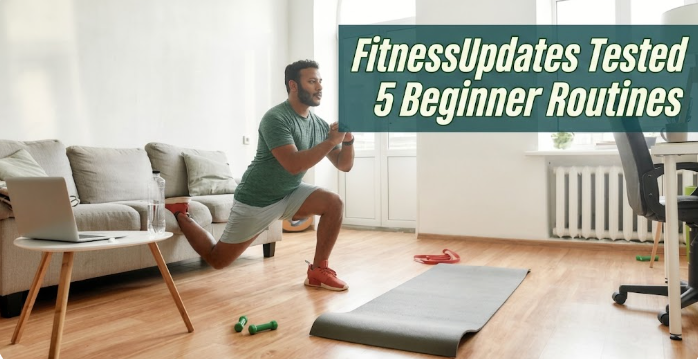
FitnessUpdates Tested 5 Beginner Routines
Most beginner workout advice online is written for people who already work out. That sounds backwards, but look closely at the average “beginner routine” article and you’ll find supersets, RPE scales, and phrases like “progressive overload” dropped in without explanation. None of that is wrong exactly. It’s just aimed at someone who has already been in a gym for a year, not someone standing in one for the first time wondering which machine to sit on.
This piece looks at five routine formats that actually get recommended to beginners constantly: bodyweight circuits, a classic full-body strength split, a beginner-adapted push/pull/legs schedule, walking-based cardio paired with light resistance work, and app-guided programs. Not which one is “best” in the abstract, because that depends entirely on the person, but how each one behaves once real life gets involved. Missed days, sore shoulders, a schedule that only allows three gym visits a week instead of five. That’s where routines actually succeed or fail.
1. What “beginner routine” usually means (and why that’s often the wrong starting point)
When people search for a beginner routine, they’re usually handed a spreadsheet of sets and reps and told to follow it for eight to twelve weeks. The problem isn’t the spreadsheet. It’s that most beginners aren’t struggling with programming. They’re struggling with consistency, form confidence, and knowing what “enough” feels like on a given day. A near-perfect program followed inconsistently loses to a mediocre program followed three times a week without fail.
That reframes the whole comparison. Instead of asking which routine builds strength fastest on paper, the better question is: which one can this specific person actually stick with for the next two months. FitnessUpdates gets asked some version of this question constantly, and the honest answer changes depending on someone’s schedule, injury history, and whether they have access to a gym at all.

2. The five routines, side by side
Here’s a plain comparison of how these five formats actually differ in practice, not just in theory.
| Routine | Sessions/week | Equipment needed | Best suited for | Common failure point |
|---|---|---|---|---|
| Bodyweight circuit | 3-4 | None to minimal | Home training, travel, low intimidation | Plateaus fast without added resistance |
| Full-body strength (barbell or dumbbell) | 3 | Gym access | People who want visible strength gains | Requires learning 4-5 movement patterns correctly |
| Beginner push/pull/legs | 3-6 | Gym access | People who enjoy structure and routine | Too much volume too soon for true beginners |
| Walking + light resistance | 4-5 | Minimal, some dumbbells or bands | Older beginners, anyone returning after injury | Underestimated as “not a real workout,” gets dropped |
| App-guided program | 3-5 | Varies | People who want decisions made for them | Loses effectiveness once the program ends and guidance stops |
None of these is objectively superior. A full-body strength split will outperform a bodyweight circuit for raw strength, but only for the person who actually shows up to the gym three times a week for it. If gym access is the barrier, that advantage is irrelevant.
3. Where most beginners actually fail (it’s rarely the routine)
Here’s where people usually go wrong, and it has almost nothing to do with which of the five routines above they picked. It’s skipped warm-ups, doing too much too soon, and quitting somewhere around week three when motivation naturally dips and nothing has replaced it yet.
The warm-up one deserves a specific mention because it gets dismissed constantly. Skipping it occasionally isn’t catastrophic, but as is skipping a warm-up ever actually okay covers in more depth, doing it habitually is usually what turns a minor niggle into something that sidelines a person for weeks. Shoulder issues are a frequent example. Anyone who has felt shoulder discomfort creep in and worsen with every session should read why shoulder pain gets worse after every single workout, because the cause is very often not the exercises themselves but the warm-up, range of motion, and recovery being ignored around them.
And then there’s the drop-off. A large share of new gym members stop showing up within the first six to eight weeks, and it’s rarely because the routine failed them technically. FitnessUpdates covered this pattern in why new gym goers quit so fast, and the short version is that motivation is treated as the plan, when it should only ever be the spark that starts one.
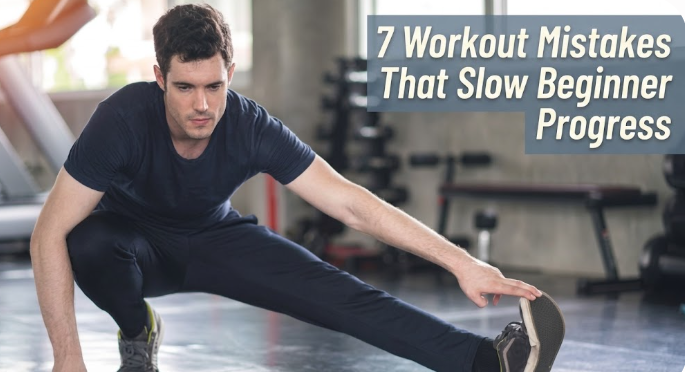
A quick gut check on volume matters here too. Beginners frequently copy routines meant for intermediate lifters, adding extra sets because more feels like it should mean better. It usually just means more soreness and a higher chance of skipping the next session out of dread. For a longer breakdown of this and other common missteps, 7 workout mistakes that slow beginner progress is worth reading before locking in any of the five routines above.
4. Matching a routine to your actual week, not your ideal week
People tend to plan their training around the week they wish they had. Five gym days, an hour each, no interruptions. Then the actual week arrives with a late meeting, a sick kid, or simple exhaustion, and the plan collapses because it had no slack built into it.
A more realistic approach starts with the number of days someone can reliably commit to, not the number that sounds impressive. Someone who can genuinely manage three consistent sessions a week is better served by the full-body strength split than by a six-day push/pull/legs routine they’ll complete twice before abandoning. This is less about ambition and more about arithmetic. Three honest sessions a week for three months adds up to more actual training than five planned sessions that only happen half the time.
It’s also worth building in a buffer day, one session that can flex to whichever day actually has time, rather than assigning fixed days that fall apart the moment one gets missed.

5. Home versus gym, for each of these five
Three of these five routines work perfectly well at home: bodyweight circuits, walking plus light resistance, and most app-guided programs. The other two, full-body barbell strength and structured push/pull/legs, really do benefit from gym equipment, though dumbbell-only versions of both exist and work reasonably well for a beginner’s first several months.
This is a bigger decision than it sounds, and not purely a convenience question. Home workouts vs gym training, which one wins breaks down the tradeoffs in more detail, but the short answer is that the gym wins on equipment variety and progressive overload options, while home wins on the thing that actually determines results for most beginners: whether the workout happens at all.
Picking one
No single routine here is the answer for everyone reading this. Someone coming back from a shoulder injury has a very different starting point than someone who has never trained at all. What tends to work, regardless of which of the five gets chosen, is picking the one that fits the week already being lived, not the week someone hopes to eventually have. Adjust from there once the habit exists. Not before.
FAQs
Is it bad to switch between these routines in the first few months? Not inherently, though switching every week or two makes it hard to tell what’s actually working. Give any routine at least four to six weeks before deciding it isn’t a fit.
How sore should a beginner expect to be after starting one of these? Some soreness in the first two weeks is normal, especially with the strength-focused options. Soreness that limits basic movement for more than a couple of days, or that shows up in a joint rather than a muscle, is a signal to scale back rather than push through.
Do beginners need a rest day between every session? Not always, but most beginners recover better with at least one full rest day between strength-focused sessions in the first two months. Walking-based routines are more forgiving and can often be done on consecutive days.
Which of these five is realistic with only two days a week available? The walking plus light resistance format and a trimmed-down full-body strength routine both adapt reasonably well to two sessions, as long as expectations for pace of progress are adjusted accordingly.
Is an app-guided program a crutch, or actually useful for beginners? It’s genuinely useful for a lot of people, mainly because it removes decision fatigue. The tradeoff shows up later, when the program ends and the person hasn’t built an independent sense of how to adjust training on their own.
For more breakdowns like this one, fitnessupdates.org has additional guides on beginner training, recovery, and common early mistakes.




2 Comments