Fitness Updates: Top 3 Stories This Week

Something landed on my screen last Tuesday that stopped me mid-coffee. Researchers analyzing Fitbit data from people taking GLP-1 medications found that after starting the drugs, daily step counts dropped. Exercise levels went down, not up.
The assumption everyone in this industry has been making is that losing weight makes you want to move more. You feel lighter, you feel capable, the body starts working with you again. That logic is intuitive. And for a growing portion of the people actually on these medications, it appears to be wrong.
That story alone would have been enough for a week. But there were two others worth pausing on, each one quietly challenging something the fitness world treats as settled.
1. The Ozempic Problem Nobody Saw Coming
Researchers reviewed Fitbit movement data from people who started taking GLP-1 receptor agonists — the class that includes Ozempic, Wegovy, Mounjaro, and Zepbound — and found a consistent pattern. After beginning the medication, step counts fell and overall exercise frequency dropped alongside them.
The weight was coming off. The activity wasn’t following.
I’ve spent twenty-eight years in this industry watching people confuse weight loss with fitness improvement. They’re related, but they’re not the same thing. And the GLP-1 data makes that gap visible in a way that’s hard to argue with. Someone who loses thirty pounds through appetite suppression but stays sedentary has not improved their cardiovascular output, their muscle recruitment capacity, their bone density, or their ability to produce and absorb force over time. The scale has moved. The body hasn’t necessarily gotten more capable.
There’s also a lean mass problem that the broader conversation keeps avoiding. GLP-1 drugs suppress appetite aggressively. Without deliberate protein intake and resistance training running alongside them, a meaningful portion of the weight lost comes from muscle, not fat. Some reviews put that ratio close to one-third muscle to two-thirds fat in drug-only protocols.
The fix is not complicated. It’s just not being communicated clearly to people starting these prescriptions. If you or someone you know is on a GLP-1 medication, this piece on protein intake and muscle preservation at fitnessupdates.org gives the context that should be sitting next to every prescription label.
The weight loss conversation has always treated exercise as optional. This is what optional looks like in the data.

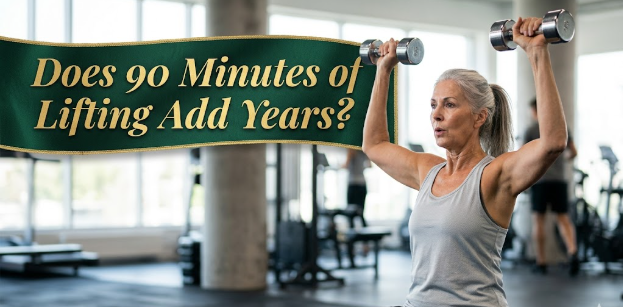
2. 90 Minutes a Week Is the Number. Not 300.
The second story this week is one I’ve honestly been waiting years to see covered at scale. A 30-year study published in the British Journal of Sports Medicine tracked 147,374 participants across three major cohort studies: the Health Professionals Follow-up Study, both editions of the Nurses’ Health Study, and it followed them across three decades. The finding specifically on resistance training is worth sitting with.
Participants who logged 90 to 119 minutes of strength training per week showed a 13% lower risk of death from any cause. That’s three sessions of roughly thirty minutes each. Two sessions and one slightly longer one. Whatever weekly structure gets you there. The protection was even stronger when strength work was combined with aerobic exercise, but the resistance training alone produced measurable life-extending effects even when aerobic volume was low.
Here is what bothers me about the way this research will likely be communicated publicly. The dominant public health message has been built around 150 minutes of moderate aerobic exercise per week. Resistance training has been the footnote, the secondary recommendation, the thing you add once you’re already running or cycling regularly. This data doesn’t support that hierarchy. Muscle-strengthening activity at a modest, consistent volume carries protective effects that deserve the headline, not a supporting role.
The sweet spot being below 120 minutes is also the practically important part. People tell me constantly, constantly, that they don’t have time to train. Ninety minutes across an entire week. Three lunch breaks. Two evenings and a Saturday morning. The barrier has never been the time, not really. It’s been the belief that anything short of an hour a day barely counts.
If you’re building a training structure from scratch and want something that fits within that kind of weekly volume, the full guide to starting home workouts on fitnessupdates.org has a practical breakdown that works for most starting points.
And the finding about diminishing returns beyond 120 minutes matters too. More strength training volume didn’t continue producing proportionally larger longevity benefits above that threshold. You don’t need long sessions. You need consistent moderate-volume work over years, not hours.
3. Fitness Decline Starts at 35. The Story That Should Change Behavior But Probably Won’t.
Karolinska Institutet published findings from the Swedish Physical Activity and Fitness study, a 47-year tracking effort that followed hundreds of men and women between the ages of 16 and 63. The finding that stood out: fitness, strength, and muscle endurance begin declining around age 35.
Not 50. Not 45.
Thirty-five.
The decline is gradual initially and accelerates with age, but the trajectory is established earlier than most people expect. What the study also found, and this is the part I want people to actually absorb, is that participants who became active later in adulthood still increased their physical capacity by 5 to 10 percent. The window doesn’t close at 35. But the starting point matters more than most people are willing to believe when they’re 32 and still treating exercise as something they’ll take seriously later.
I’ve had this conversation in different forms for most of my career. At Escape Fitness, we see it with gym operators and the client populations they serve. The people who are genuinely capable and independent in their sixties almost always started taking muscle preservation seriously in their thirties, not in their late forties after a health event gave them no other option. The people who wait until something breaks come in doing repair work and catch-up simultaneously, and that’s a harder place to start from.
The research gives me something concrete to point to now. The body begins its recalibration whether you’re paying attention to it or not.
One thing that rarely gets discussed alongside this data is the hormonal picture in that 35 to 45 window, specifically what happens to cortisol when physical training drops off during a period of accumulating stress. This breakdown on cortisol levels when you stop working out at fitnessupdates.org explains why deconditioning during high-stress years carries compounding effects that aren’t immediately obvious.
If you’re past 35 and feeling like you’ve missed the window, you haven’t. A 5 to 10 percent improvement in physical capacity is not a consolation prize. It’s the difference between a decade of capable, independent living and a decade of managed decline.

This Week at a Glance
| Story | Source | What It Actually Means |
|---|---|---|
| GLP-1 users moving less | Fitbit data analysis, June 2026 | Weight loss medication did not produce increased movement; exercise must be deliberately maintained alongside it |
| Strength training sweet spot | British Journal of Sports Medicine, 30-year study of 147,374 people | 90-119 min/week resistance training linked to 13% lower all-cause mortality; more is not proportionally better above 120 minutes |
| Fitness decline begins at 35 | Karolinska Institutet, 47-year SPAF study | Physical capacity starts declining in mid-thirties; starting at any point in adulthood still produces 5-10% improvement |
All three stories are pointing at the same underlying problem. The fitness conversation has accumulated a set of assumptions that don’t hold up to long-term data. Medication produces movement. More hours always mean more benefit. Decline is a later-life concern. Each one of those breaks under scrutiny. And people are making real decisions based on them every week.
These are the kinds of findings that fitnessupdates.org tracks specifically because the nuance is what changes behavior, not the headline.
FAQs
Should someone on Ozempic or Wegovy be strength training at the same time?
Yes. Resistance training alongside GLP-1 medications helps preserve lean muscle mass, which is actively at risk when aggressive appetite suppression leads to insufficient protein intake. Even two or three sessions per week shifts the body composition outcome meaningfully. The goal isn’t just lower body weight. It’s retaining the muscle that makes the lower weight functionally useful.
Does the 90-minute strength training threshold need to be at high intensity to work?
The study measured volume across the week, not intensity. Moderate-load resistance training performed consistently appears sufficient to produce the longevity benefit. Training to failure every session isn’t required, and may actually work against consistency over time.
I’m 41 and haven’t trained seriously in years. Is it too late to make a real difference?
No. The Karolinska study found that people who became active during adulthood improved physical capacity by 5 to 10 percent regardless of when they started. Sarcopenia responds to resistance training across a wide age range. Later is genuinely better than never, and the 5 to 10 percent gain isn’t a symbolic number. It has real consequences for how your body functions through the next decade.
Why do GLP-1 drugs appear to reduce movement rather than increase it?
The mechanism isn’t fully established yet. One hypothesis is that the drugs reduce not just hunger but general motivation and drive, through their action on dopamine pathways in the brain alongside GLP-1 receptors. Another is simply that fatigue and nausea from the early adjustment period discourages movement, and that sedentary pattern then persists. More research is being done, but the behavioral pattern in the data is consistent.
If fitness starts declining at 35 regardless, is there any point starting strength training before then?
The protective effects of training before age 35 are real, even if decline still begins around that point. People who built a strong fitness base before 35 tend to decline from a higher starting point, which means their functional capacity in their fifties and sixties remains meaningfully higher even with the same rate of decline. Think of it as building the largest reservoir possible before the slow drain begins.
For more on how the metabolism responds to extended dietary restriction: what happens to your metabolism after a long diet