Is Walking Enough Exercise for Real Fat Loss?
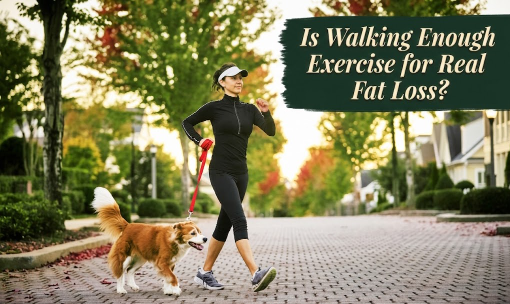
The number of times I’ve sat across from someone who told me they were finally “getting serious” about fat loss, and their entire plan was a 30-minute morning walk — I’ve genuinely lost count. And it’s not a niche conversation. I’ve had it in gym settings, at industry events, with friends, with clients. People reach for walking because it’s low-risk, it feels like something, and somewhere along the line it became the go-to answer when any health professional asks “are you getting enough exercise?”
I’m not here to tear walking down. But I am going to be direct about what the research actually shows, because there’s a meaningful gap between what most people believe walking will do for fat loss and what it actually delivers. That gap is costing people months of effort with very little to show for it.
1. Why Walking Gets So Much Credit
The reputation isn’t entirely undeserved. Walking contributes to what researchers call NEAT, or Non-Exercise Activity Thermogenesis — the calorie burn that accumulates from all movement outside of structured exercise. Things like pacing while on a call, carrying bags, climbing a flight of stairs. It’s background activity that adds up.
What’s striking is how much NEAT can vary between individuals. Studies measuring total daily energy expenditure have found differences of up to 2,000 calories per day between people of similar size and weight, driven almost entirely by how much incidental movement they get. People who fidget constantly, walk to do errands, and stay on their feet during the day have a significant metabolic advantage over people who move only when they have to.
So walking more is a real tool. The question is whether it’s a sufficient tool for someone whose specific goal is fat loss.
It rarely is. And here’s why.
2. What Walking Actually Does to Your Fat Stores
At a moderate pace — around 3 miles per hour — an average adult burns somewhere between 80 and 110 calories per mile. Body weight, terrain, and individual metabolic rate all influence this. For a 180-pound person, a comfortable one-hour walk burns roughly 300 to 350 calories.
One pound of body fat stores approximately 3,500 calories of energy. To lose that pound in a single week through walking alone, you’d need to walk an extra 10 to 12 miles per day, every day, beyond your current activity baseline. And that number assumes nothing else changes — your diet stays the same, your stress stays the same, your sleep is solid.
That’s not a realistic daily target for most working adults.
But there’s an additional problem beyond the raw math. Research on exercise and appetite has shown, fairly consistently, that moderate-intensity exercise like walking tends to increase hunger in proportion to the energy it burns. You go for an extra hour, you come home and eat a bit more. The body is not a passive machine — it responds to energy deficits by increasing hunger signals, often partially offsetting the calories burned. This is why I always make the point at fitnessupdates.org that exercise and nutrition are not independent variables. You can’t treat them as separate levers and expect the math to work cleanly. If you haven’t looked at the foundational fat loss habits alongside your activity plan, the article on easy fat loss habits you can start today covers this interaction in practical terms.

3. The Adaptation Problem Nobody Talks About
Your body is designed to become efficient. That’s not a flaw — it’s a survival mechanism. But when you’re trying to create a sustained caloric deficit, it becomes the enemy.
In the first few weeks of a new walking routine, your body is working harder than it’s used to. Calorie burn is relatively high, your heart rate is elevated for longer, your muscles are experiencing new load. After six to eight weeks of walking the same route at the same pace, your body adapts. The energy cost drops. You burn measurably fewer calories for the same effort, at the same distance.
Studies measuring oxygen consumption in regular walkers have documented this adaptation effect clearly. And the only way to outrun it is to keep adding distance, speed, or incline — an escalation that’s hard to sustain indefinitely, and still doesn’t address what’s likely the most important factor in long-term fat loss: your muscle mass.
4. Muscle Mass, Metabolism, and the Missing Piece
Walking is aerobic activity. It trains the cardiovascular system, elevates heart rate, and burns calories while you’re doing it. What it does not do is provide meaningful stimulus for muscle preservation or growth. The load is too low and the pattern of movement too repetitive to trigger the kind of muscle protein synthesis you’d get from resistance training.
This matters for a specific reason. Muscle tissue is metabolically expensive to maintain. It burns more calories at rest than fat tissue does. People with higher lean muscle mass have higher resting metabolic rates, meaning they burn more energy doing nothing. It’s a compounding advantage, and it’s one of the main reasons two people can follow the same diet and get very different results based on how much muscle they’re carrying.
Here’s where the typical “I’ll just walk and eat less” approach runs into real trouble. When you restrict calories and rely only on low-intensity activity, the body doesn’t selectively burn fat. It burns fat and muscle together. Without adequate dietary protein and without a resistance training stimulus, lean tissue losses are common during weight loss phases. The scale might show progress, but body composition — the actual ratio of fat to muscle — can get worse.
Resistance training changes this. Even two sessions per week sends a clear enough signal to preserve lean tissue while in a caloric deficit. And when you combine that with consistent daily movement like walking, your weight loss results become significantly stronger and more durable than walking alone would ever produce.
Walking vs. Other Exercise Modalities for Fat Loss
| Factor | Walking | Strength Training | HIIT |
|---|---|---|---|
| Calories burned per hour | 200-350 | 250-450 | 400-600 |
| Afterburn effect (EPOC) | Very low | Moderate | High |
| Muscle preservation | Minimal | Significant | Moderate |
| Speed of adaptation | Fast (6-8 weeks) | Slower | Moderate |
| Joint stress | Low | Moderate | High |
| Daily sustainability | Very high | Moderate | Low-Moderate |
| Primary benefit | NEAT, recovery, baseline activity | Body composition, metabolism | Efficiency, calorie output |
EPOC refers to Excess Post-Exercise Oxygen Consumption — the elevated calorie burning that continues after you finish a workout. High-intensity and resistance-based exercise can keep metabolism elevated for 24 to 36 hours after the session. Walking produces almost none of this effect.
5. When Walking Actually Is Enough
Being precise here matters. There are real situations where walking is exactly the right tool and nothing more is needed.
If you’ve already achieved a healthy body composition through a combination of good nutrition, structured training, and consistent habits — and your current goal is maintenance rather than further fat loss — daily walking can absolutely serve as your primary physical activity. Your metabolic rate is already elevated, your muscle mass is intact, your dietary habits are working. Walking keeps NEAT high and prevents the slow slide toward sedentary behavior.
For older adults, particularly those over 65, who are focused on cardiovascular health, mobility, and fall prevention rather than body recomposition, walking is genuinely excellent medicine. The risk-to-benefit ratio of higher-intensity exercise shifts with age, and for that population, daily walking may produce more overall health benefit than pushing into zones that carry higher injury risk.
During injury recovery or illness, walking is often the smartest thing you can do. It supports circulation, maintains some cardiovascular fitness, helps mood, and avoids loading tissue that’s still healing.
But for someone in their 30s, 40s, or 50s who wants to actually change their body composition — to reduce body fat while preserving the muscle underneath — walking is a foundation, not the whole building. The daily habits that actually produce fat loss are not complicated, but they involve more than a single mode of activity. The breakdown of daily habits that help with real weight loss covers this comprehensively, and it’s worth looking at if you’re still relying on a single approach.

The Honest Breakdown
Walk every day. I mean that. Walking reduces cardiovascular disease risk, improves blood sugar regulation, supports mental health, and contributes to your daily caloric expenditure in ways that matter over time.
But fat loss — actual changes to body composition — demands more than walking alone can deliver. It requires a sustained caloric deficit. It requires enough dietary protein to protect lean tissue. And it requires some form of resistance training to prevent the muscle loss that almost always accompanies caloric restriction without adequate mechanical stimulus.
The people who get lasting results are rarely the ones who found one magic thing. They built several habits that reinforced each other. That’s what the evidence points toward, and that’s what fitnessupdates.org consistently covers when looking at fat loss realistically.
Walk. But build around it.
FAQs
How many steps per day do I need for fat loss?
The 10,000-step target gets cited constantly, but its clinical basis for fat loss is thin. It originated from a 1960s marketing campaign for a Japanese pedometer, not from a research trial. That said, targeting 7,000 to 10,000 steps daily does meaningfully increase NEAT and contributes to a caloric deficit over time. The more important point is that steps alone, without dietary adjustment, rarely produce significant fat loss. Treat step goals as a helpful daily floor, not a complete fat loss strategy.
Can I lose belly fat specifically by walking every day?
Spot reduction doesn’t work. The idea that you can burn fat from a specific area by exercising near it isn’t supported by physiology. Walking contributes to total caloric expenditure, which over weeks and months can reduce overall body fat including abdominal fat. But the research is consistent: dietary protein intake combined with resistance training is considerably more effective at reducing visceral fat than walking alone.
Is walking better than running for fat loss?
This comparison is often framed incorrectly. Running burns more calories per minute, but it also carries significantly higher injury risk and is harder to sustain daily. Walking is low-impact, recoverable, and can be done every single day. A person who walks 60 minutes daily often accumulates more weekly caloric burn than someone who runs 30 minutes three times a week, particularly if that runner is regularly sidelined with joint issues.
| Walking 60 min/day | Running 30 min, 3x/week | |
|---|---|---|
| Est. weekly calorie burn (180 lb person) | ~2,100 | ~1,050 |
| Training days per week | 7 | 3 |
| Cumulative injury risk | Low | Moderate to High |
Does walking help preserve muscle when I’m dieting?
Not meaningfully. Walking doesn’t provide sufficient mechanical load to signal muscle preservation during a caloric deficit. Resistance training does that. Without it, calorie restriction tends to result in losing both fat and muscle, which improves the number on the scale but worsens actual body composition. Two resistance training sessions per week is enough to substantially change this outcome.
What walking pace actually burns the most fat?
A brisk pace of 3.5 to 4 mph — fast enough that you’re working slightly but can still hold a conversation — keeps you in an aerobic zone where fat oxidation is proportionally high. Walking at this pace for 45 to 60 minutes, especially in a fasted state in the morning, does shift the fuel mix toward fat. The difference versus a slower pace is real but not enormous. Consistency at any reasonable pace beats occasional high-intensity efforts every time. And pairing that consistent walking habit with the nutrition support covered in the science-backed nutrition updates on fitnessupdates.org makes the walking far more effective than it would be in isolation.