Why You Lose Weight Fast at First Then Nothing at All
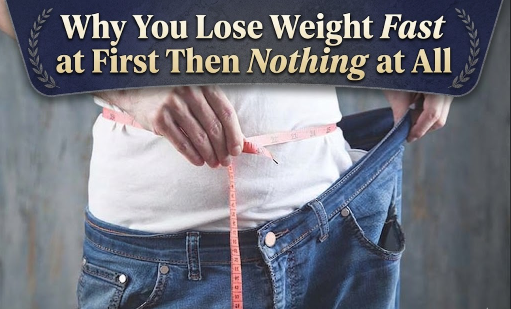
The one thing I kept hearing from people who were starting a weight loss plan, over and over across nearly three decades in this industry, was some version of: “It was working and then it just stopped. I must be doing something wrong.”
They weren’t.
Or at least, they weren’t doing anything more wrong than they were in week one. What changed wasn’t their effort or their discipline. What changed was their body, quietly and systematically, working exactly as it was designed to.
That distinction matters a lot. Because if you believe you broke something, you’ll try to fix it in ways that usually make things worse. If you understand what’s actually happening under the surface, you have something to actually work with.
1. What You’re Actually Losing in the First Two Weeks
The number on the scale in week one is not fat. Not most of it.
When you cut your calories or reduce carbohydrates, your body burns through its glycogen stores before it makes a meaningful dent in body fat. Glycogen is your body’s fast-access fuel, stored in your muscles and liver, and the important detail is that glycogen binds to water. Every gram of it holds roughly three grams of water alongside it. So when those stores get depleted, you lose both the glycogen and the water it was holding.
That shows up on the scale as weight. It shows up fast. And it feels like the plan is working brilliantly.
Someone dropping from 2,500 to 1,800 calories a day might see three, four, even five pounds disappear in the first ten days. That feels significant. The problem is that the actual fat loss happening during that same window is probably closer to half a pound, maybe one pound at the aggressive end.
The body hasn’t started fighting the deficit yet. The hormones haven’t adjusted. The metabolism hasn’t had time to respond. So week one is genuinely, almost artificially easy, and everything after that is the real picture.

2. The Mechanism Your Body Uses to Push Back
Once the initial water weight is gone and real fat loss begins, the body does something completely rational from a survival perspective, and deeply inconvenient from a dieting one. It adapts.
This is called adaptive thermogenesis, and it’s one of the most consistently misunderstood processes in weight management. As your body weight drops, your total daily energy expenditure drops with it. Part of that is predictable: a lighter body simply needs fewer calories to function. But research going back to the Minnesota Starvation Experiment and later work from the New York Obesity Research Center showed that the reduction in metabolic rate is consistently greater than body weight alone would explain. Your physiology quietly downregulates. Thyroid hormone output shifts. Muscle efficiency at the cellular level changes. You burn fewer calories doing the same workout because your body has adjusted to it.
And then there’s NEAT, which doesn’t get nearly enough attention.
NEAT stands for non-exercise activity thermogenesis. It covers everything your body does outside of structured exercise: walking between rooms, shifting in your chair, gesturing while you talk, holding your posture differently throughout the day. Under sustained caloric restriction, NEAT drops significantly. Not because you make a decision to move less, but because your body reduces output automatically, without your awareness or consent. Studies published in the American Journal of Clinical Nutrition found that NEAT can fall by 300 to 400 calories per day during prolonged caloric restriction. That’s a significant number disappearing from your energy expenditure without a single conscious choice.
The deficit that was producing results in week three has shrunk. Not because you changed anything, but because your body changed everything.
3. What Your Hormones Are Doing Behind the Scenes
Two hormones are running quietly in the background of every plateau, and most people haven’t heard of either one in this context.
Leptin is released by fat cells and signals to your brain that you have enough stored energy. When fat mass decreases, leptin levels fall, sometimes dropping to 60 to 70 percent below baseline after meaningful weight loss. At that point, your brain is receiving signals that suggest energy emergency, even if you’re still carrying significant body fat. It responds accordingly: it increases hunger, reduces energy output further, and prioritizes preservation.
Ghrelin does the opposite. It’s your hunger-signaling hormone, and it rises under caloric restriction. You feel hungrier. You think about food more. You find it harder to hold to decisions you were making easily four weeks ago. This isn’t weakness. It’s physiology.
On top of that, cortisol tends to rise under prolonged dietary stress, and elevated cortisol drives water retention and promotes fat storage, particularly centrally. Which means you could be losing fat and still watching the scale refuse to budge because you’re holding extra fluid. A lot of people interpret this as a plateau. It’s actually just water masking the progress underneath.
If you’re in this situation right now and trying to figure out what habits are still within your control, the breakdown of daily habits that actually move fat loss forward at fitnessupdates.org covers this well, particularly around managing cortisol and recovery.
At-a-Glance: What’s Actually Happening Week by Week
| Phase | What the Scale Shows | What’s Actually Happening |
|---|---|---|
| Week 1-2 | 3-5 lbs dropped quickly | Glycogen and water depletion, minimal fat loss |
| Week 3-4 | 0.5-1 lb per week | True fat loss begins; body starting to adapt |
| Week 5-8 | Rate noticeably slowing | NEAT declining; adaptive thermogenesis underway |
| Week 8-12 | Near-stall or apparent plateau | Hormonal shifts; original calorie gap has narrowed |
| Week 12+ | No movement or backwards | Recalculation and structural change needed |
4. Where People Make It Worse
This is the part I want to be direct about, because it’s where months of solid progress typically get undone.
The most common response to a plateau is to cut calories further. Someone was eating 1,800 and hit a wall, so they drop to 1,500. Then 1,300. The logic seems obvious enough: if a deficit caused weight loss before, a bigger deficit will restart it. But by this point, the body’s energy output has already dropped substantially. Pushing the deficit harder doesn’t override that. It accelerates muscle loss, deepens the hormonal disruption, and makes the rebound after the diet far harder to avoid.
Muscle is metabolically active tissue. It burns calories at rest. Every pound of it you lose during a diet makes long-term weight maintenance more difficult, and this is one of the strongest practical arguments for keeping protein high throughout a fat loss phase. Not just reasonable, genuinely high. For most adults in a deficit, that’s in the range of 0.7 to 1 gram per pound of bodyweight per day. Most people eating to lose weight are nowhere near that.
The second mistake is using the scale as the only form of feedback. Body composition can shift considerably, and improve, while the number stays identical. If someone is losing fat and maintaining or even building a small amount of muscle at the same time, the scale might not move for two or three weeks. But their measurements are changing. Their clothes fit differently. Their body is actually doing exactly what it should be. The scale just can’t see it.
The nutrition fundamentals covered at fitnessupdates.org are a good starting point if you want to work out how to structure eating around body recomposition rather than just chasing a number.

5. How to Get Things Moving Again Without Wrecking Everything Else
A genuine plateau, not just a slow week, usually means three things need attention.
First, recalculate. The calorie target you set at the beginning was based on your starting weight. Your current weight is lower. Your total daily energy expenditure has dropped. Running those numbers again at your actual current weight will almost certainly show that what used to be a meaningful deficit has become close to maintenance. That’s not failure. That’s just arithmetic catching up with you.
Second, consider a structured diet break. I want to be clear this isn’t a free-for-all or a reason to abandon discipline. A diet break means eating at maintenance calories for ten to fourteen days before returning to a deficit. Research from the University of Tasmania found that participants who did this lost more fat over a twenty-eight week period than those who restricted continuously. The reason is partly hormonal: leptin levels partially recover during a maintenance period. And partly behavioral: people come back to a deficit with meaningfully more psychological capacity to sustain it.
There’s also the mental side of a plateau, and I don’t want to skip past it entirely because I think it matters more than most articles acknowledge. The feeling that you’ve failed, that your body is broken, that nothing you do works, those feelings drive poor decisions. Usually either quitting or overcorrecting. And both of those outcomes are worse than just understanding what’s happening and making a calm, informed adjustment. Anyway.
Third, take a hard look at your resistance training. If you’re not doing any, start now. If you’re doing the same program you started with, your body has adapted to that stimulus. Progressive overload, gradually increasing the demand placed on your muscles over time, is what keeps training productive. The fat loss habits worth building into your routine article is a practical place to start if you’re not sure which direction to take your sessions.
Sleep is also not a small variable here. Consistently getting less than six hours keeps cortisol elevated, impairs muscle recovery, drives ghrelin up, and suppresses the willpower resources you need to make consistent food choices. If your sleep is off, fixing your training and diet without addressing that is like patching one wall of a leaking room.
The weight loss plateau is one of the most discouraging experiences in a fitness journey precisely because it arrives right when someone has already proven they can do the hard part. They made the changes. They did the weeks. And then the body responded by making those same changes less effective.
That’s not a sign things have gone wrong. It’s a sign things have gone right long enough for your biology to notice. Which means the next step isn’t panic. It’s a slightly smarter version of what you were already doing.
If you’re three weeks into a stall with no real changes in measurements either, the weight loss strategies that hold up over time are worth reviewing before reaching for a bigger caloric cut.
FAQs
Is it normal to drop 5 pounds in week one and almost nothing after that?
Yes, and it happens almost universally. The rapid early loss is mostly water weight tied to glycogen depletion, not fat. Once those stores are depleted, the rate of loss normalizes to what true fat loss actually looks like: somewhere between 0.5 and 1 pound per week for most people in a sensible deficit. That slower rate is not a problem. It’s the actual process.
How long does a real weight loss plateau last?
That depends on what’s driving it. If it’s metabolic adaptation with no calorie recalculation, it won’t resolve on its own because the caloric gap has closed. If it’s temporary water retention from stress, high sodium, or increased training volume, it usually passes within one to two weeks. Three or more weeks of no movement on both the scale and body measurements is generally the point where something structural needs to change.
Should I eat less when I stop losing weight?
Not as your first move. Before cutting further, check whether your current intake still represents a real deficit at your current, lower body weight. Then check protein intake, sleep, and training variety. Eating less is often the last adjustment to make, not the first, and further restriction without addressing those other factors tends to make things harder rather than better.
Does lifting weights actually help break a plateau?
Yes, in multiple ways. It preserves muscle tissue, which keeps your resting metabolic rate higher than it would be with cardio alone. It creates a different metabolic demand than steady-state cardio. And building even modest amounts of additional muscle over time increases how many calories your body burns at rest, which expands the energy gap needed for fat loss to resume. The thermic effect of protein also means that eating more protein and lifting consistently is a combination that tends to produce results even when the scale isn’t cooperating.
Why does hunger feel harder to manage after months of dieting than it did at the start?
Because it actually is harder, physiologically. Ghrelin, which drives hunger, increases during sustained caloric restriction. Leptin, which signals satiety and energy availability, falls as fat mass decreases. This hormonal shift is real and measurable, and it’s one of the main reasons long-term dieting requires more psychological resources over time than it did at the beginning. Structured diet breaks at maintenance, adequate sleep, and high protein intake all help moderate this, but it doesn’t disappear entirely until the diet phase ends.