
Why Eating Less Sometimes Slows Down Weight Loss
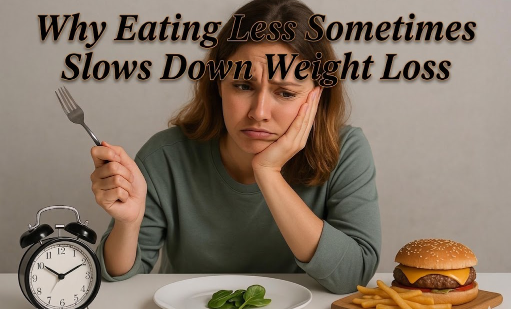
A client came to me several years ago who had been tracking every single calorie for nearly two months. She was eating around 1,100 a day, doing cardio five mornings a week, and for the last three of those weeks, hadn’t moved the scale at all. Her question was whether she should drop to 900 calories.
I told her no. I told her she needed to eat more.
That’s a hard thing to hear when every instinct says restriction is the answer. But what was happening to her body was well-documented, completely predictable, and had nothing to do with her effort or discipline. She was caught in a metabolic trap, and eating less would have pushed her deeper into it.
This isn’t an unusual situation. It happens to a lot of people, and the assumption underneath it, that cutting calories further will restart stalled weight loss, is one of the most persistent and damaging mistakes in practical nutrition. It’s worth understanding not just that it fails, but exactly why it does.
1. The Calorie Math That Stops Working
Weight loss does require a calorie deficit. That part is accurate. The problem is that most people treat the “calories burned” side of that equation as fixed, and it isn’t.
When you reduce food intake significantly, your body reduces how much energy it burns in response. This process is called adaptive thermogenesis, and the evidence for it is not subtle or contested. The Minnesota Starvation Experiment in the 1940s tracked men eating roughly 1,570 calories per day over six months and documented a metabolic rate drop of nearly 40%. More recent work following participants from major weight loss programs confirmed the pattern in a contemporary context: aggressive restriction causes measurable metabolic depression that can persist for years after the restriction period ends.
The adaptation operates through several simultaneous channels. Your resting metabolic rate drops. Your body becomes more efficient at extracting energy from the food you do eat. Your non-exercise activity thermogenesis, what researchers call NEAT, decreases. You fidget less, walk slightly slower, shift positions less throughout the day. Individually these adjustments seem minor. Collectively, they can reduce total daily calorie expenditure by 200 to 400 calories without any conscious decision on your part.
So the deficit you calculated at the start is not the deficit you’re running at week six. The equation has adjusted itself downward. And that adjustment keeps happening.

2. What Severe Restriction Does to Your Hormones
The metabolic slowdown has a clear hormonal mechanism, and understanding which hormones shift and how explains why prolonged restriction feels so relentless to the people experiencing it.
Leptin is produced by fat cells and signals to the brain that the body has adequate stored energy. In a sustained calorie deficit, leptin drops, sometimes sharply, and the brain interprets this as a shortage signal. The response is predictable: slow the metabolism, increase hunger, and cut non-essential energy expenditure. Ghrelin, the primary hunger hormone, moves in the opposite direction at the same time. It rises with restriction, amplifying hunger signals at exactly the moment you’re trying to resist them.
Thyroid function is also sensitive to calorie intake. The active thyroid hormone T3 decreases under aggressive restriction. T3 plays a direct regulatory role in resting metabolic rate, so when it drops, burn rate drops with it. Cortisol tends to rise as well, particularly when significant training volume is stacked on top of already low calories. Elevated cortisol promotes muscle catabolism and drives significant water retention, which can mask real fat loss on the scale for weeks at a time.
| Hormone | Response Under Restriction | Effect on Fat Loss Progress |
|---|---|---|
| Leptin | Decreases | Metabolism slows, hunger increases significantly |
| Ghrelin | Increases | Stronger hunger signals, reduced satiety |
| T3 (Thyroid) | Decreases | Lower resting metabolic rate |
| Cortisol | Increases | Muscle breakdown, water retention masks fat loss |
| Testosterone (men) | Decreases | Reduced capacity to preserve lean tissue |
At least three or four of these shifts are operating simultaneously in anyone who has been eating very low for more than four to five weeks. That’s a meaningful physiological load, and cutting calories further addresses none of it.
There’s a useful piece on how metabolic hormones affect body composition outcomes in the fitnessupdates.org archives that goes deeper on the T3 and cortisol interaction if you want the full picture on those two.
3. The Muscle Problem Nobody Calculates
There’s a longer-term structural consequence to aggressive restriction that most people don’t account for, and it sets up the conditions for future weight regain that feel inexplicable.
When calories drop significantly, especially without adequate protein, the body doesn’t only pull on fat stores for fuel. Muscle tissue gets broken down too. And this matters considerably because muscle is one of the most metabolically expensive tissues in the body: it burns substantially more calories at rest than the equivalent amount of fat tissue.
Lose muscle through undereating, and your resting metabolic rate decreases. That decrease is permanent unless you actively rebuild the tissue through training and adequate nutrition. So the person who spent twelve weeks eating 1,100 calories a day and lost eight pounds, but lost two of those from muscle, now has a lower daily calorie burn than before they ever started. Their maintenance calorie level has shifted downward. Any future fat loss attempt requires an even deeper cut just to create the same deficit.
This is the actual mechanism behind the common experience of “I put weight back on faster than I used to.” It isn’t a failure of willpower. The metabolic floor has been lowered.
Adequate protein is the primary defense against this. Fitnessupdates.org has covered the relationship between protein intake and muscle preservation during a calorie deficit in detail, and the research consistently lands in the same range: 1.6 to 2.2 grams per kilogram of body weight. Stay within that range while in a deficit, combine it with regular resistance training, and muscle loss is substantially reduced.
Cardio doesn’t substitute here. It burns calories during the session but sends no meaningful signal to preserve muscle tissue. Resistance training does. If you’re cutting calories and your only exercise is running, you’re accelerating a structural problem that will make every future phase of dieting harder.
4. Where Most People Actually Go Wrong
A few specific patterns come up consistently in people who’ve ended up in a metabolic stall.
The most common is the abrupt transition: going from normal eating to a very low calorie target immediately, with no gradual reduction in between. The body’s adaptive response hits harder and faster when the drop is sudden. That compresses the effective window of fat loss before adaptation catches up, sometimes to just two or three weeks.
The second mistake is treating every plateau as a reason to restrict further. A weight loss plateau after six or more weeks of consistent dieting almost certainly reflects metabolic adaptation, elevated cortisol-driven water retention, or both. Eating less at that point makes it worse reliably. But the instinct to cut more is strong, and most people follow it.
The third pattern is compensating with more cardio when the scale stops moving. Additional cardio sessions on top of significant restriction increase cortisol, accelerate muscle catabolism, suppress leptin further, and often push a stall into a prolonged freeze. And then more cardio gets added. I’ve watched people end up training for two hours a day while eating under 1,000 calories, genuinely confused about why nothing is moving. The recovery from that state can take four to six months of careful re-feeding before metabolism normalizes.
And then there’s NEAT reduction, which is subtle. When calories are low, the body unconsciously reduces spontaneous movement. Fewer steps, less fidgeting, smaller incidental physical efforts across the day. This can reduce total daily expenditure by 200 to 400 calories without any awareness on your part, silently closing the deficit you thought you were holding.
If you’re working out how to structure your training during a fat loss phase without triggering these cascades, this overview of training volume and fat loss tradeoffs is worth going through alongside this.

5. What the Evidence and Experience Both Point To
A moderate deficit, 300 to 500 calories below your actual total daily energy expenditure, produces slower short-term results but substantially better outcomes at three to six months. Metabolic adaptation is less severe. Hormonal disruption is less pronounced. Muscle retention is meaningfully better. The slower rate isn’t a compromise you’re making. It’s the rate that actually works.
High protein is non-negotiable throughout. Not for any metabolic magic reason, but because adequate protein is the practical tool that preserves muscle while fat is drawn on for fuel. Set that number first. Fill remaining calories with carbohydrates and fats in whatever ratio suits your training demands and preferences.
Diet breaks work, and the research supports them clearly. Returning to maintenance calories for two weeks every six to eight weeks of cutting allows leptin levels to recover, cortisol to normalize, and provides a reset before returning to a deficit. Studies comparing continuous restriction protocols to intermittent diet break approaches generally show equal or better total fat loss over the same time period, with meaningfully better muscle retention in the diet break groups.
Refeed days serve a shorter-term version of the same function. One or two days near or at maintenance, with an emphasis on carbohydrate intake, helps restore leptin sensitivity and reduces the psychological pressure that prolonged restriction builds steadily over time.
None of this is fast. But the consistent fat loss that holds isn’t built on restriction depth. It’s built on patience and not sabotaging your metabolism in the first few months.
There is a point in prolonged restriction where eating more is the correct next intervention. Not as a reward, not as a break, but as the actual strategy. The body isn’t working against you when it slows down under calorie restriction. It’s doing exactly what it evolved to do. Work with that, and results follow. Try to override it indefinitely, and it wins every time.
FAQs
How few calories is too few before weight loss stops responding?
For most adults, consistently eating below 1,200 calories per day (women) or 1,500 calories per day (men) without medical supervision is where metabolic and hormonal consequences become significant risks. But the calorie number alone doesn’t tell the full story. Protein intake, resistance training, duration of restriction, and overall stress load all influence whether a given intake level causes problems. The better question is whether your current intake is preserving muscle and supporting hormonal function, not just whether you’ve hit a specific floor.
Is “starvation mode” a real thing or is it overhyped?
The mechanism is real, though the name overstates the drama. Your body won’t completely halt fat burning, but it will reduce metabolic rate enough to effectively close a deficit that was previously working. The Minnesota Starvation Experiment is the most cited evidence of this, documenting a 40% metabolic rate reduction in controlled conditions. More recent research on post-diet metabolic suppression in weight loss competition participants confirmed the same pattern persists long after restriction ends. It isn’t a myth, it just doesn’t operate as suddenly or completely as the popular version suggests.
Why am I not losing weight when I’m eating only 1,200 calories?
Several things are likely operating together: metabolic adaptation reducing your resting burn rate, muscle loss lowering your baseline metabolic rate, elevated cortisol causing water retention that masks actual fat loss, and NEAT reduction quietly closing the deficit you think you’re maintaining. In most cases, the answer is not to eat less. A two to three week period at maintenance calories, combined with high protein and resistance training, followed by a return to a moderate deficit, produces better outcomes than continuing to restrict from an already depressed metabolic state.
How quickly does metabolic adaptation actually set in?
Measurable adaptation can begin within three to four weeks of consistent aggressive restriction, though the rate varies by deficit size, protein intake, training volume, and individual factors. This is a practical argument for moderate deficits: they delay and reduce the magnitude of adaptation, which extends the effective window of fat loss before a plateau arrives. An aggressive deficit might produce faster initial results but hits a hard wall in half the time.
Should I actually take a full two-week diet break if I’ve been stuck?
Yes, and it’s well supported. Two weeks at maintenance calories is enough for leptin to recover meaningfully, cortisol to reduce, and metabolic rate to partially normalize before returning to a deficit. The scale will likely go up slightly at first, primarily water weight from glycogen restoration, but that stabilizes within a week. When you return to a moderate deficit afterward, the hormonal environment is more favorable for actual fat loss than it was when severely restricted. The research comparing continuous restriction to planned diet break protocols consistently shows this approach is not less effective. In many cases it’s more effective, with better muscle retention throughout.
Further reading on managing fat loss without compromising metabolic function long-term, including coverage of protein strategy, training structure during a cut, and how to build eating patterns that hold up over months rather than weeks, is available across the fitnessupdates.org archives.