Why Belly Fat Stays Even After Losing Weight Overall
Twenty-three pounds down. That’s what the scale said. And the person standing in front of me had done the work: twelve weeks of consistent training, cleaned up their diet, tracked their calories properly. Arms were noticeably leaner. Face was sharper. The change was real. But they pulled up their shirt, pointed at their midsection, and said, “Why hasn’t this moved at all?”
I’ve had that exact conversation more times than I can count over nearly three decades in this industry. For a long time, the standard answer from fitness professionals was essentially: keep going, it’ll come off eventually. That answer is incomplete. And in some cases, it’s actively pointing people in the wrong direction.
The belly doesn’t behave like the rest of the body. Once you understand why, the frustration starts making sense, and the path forward gets a lot clearer.
1. The Myth That Fat Loss Is Even Across the Body
Most people enter a weight loss effort carrying an assumption that goes something like this: create a caloric deficit, the body burns stored fat, fat disappears proportionally from everywhere. Clean logic. Also not how human physiology works.
Fat is not stored uniformly, and it doesn’t get used uniformly. Where fat accumulates, and where it gets mobilized first, depends on blood flow, receptor density, and the hormonal environment in which that fat depot exists. Different regions have very different fat cell profiles.
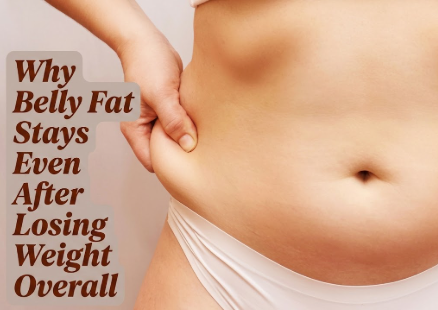
The abdominal area contains two distinct types of fat. Subcutaneous fat sits just beneath the skin, the kind you can pinch. Visceral fat lies deeper, wrapping around the organs inside the abdominal cavity. These two types respond differently to diet, differently to exercise, and differently to hormonal signals. Treating them like a single unified problem is why a lot of well-executed weight loss programs don’t produce the body composition changes people expect.
Visceral fat is more metabolically active and turns over faster when conditions are right. Subcutaneous belly fat, especially lower abdominal fat, is more stubborn because it carries a different receptor profile. More alpha-2 adrenergic receptors, which blunt the fat-releasing signal. Less vascularity, which means slower mobilization even when lipolysis does occur.
The face loses fat first in most people because it’s highly vascularized and receptor profiles favor fat release. The belly, particularly the lower belly and flanks, is essentially the last region to respond in any meaningful way. That’s not a personal failing. It’s biology.

2. The Hormonal Reality That Keeps Belly Fat Locked In
This is the part most gym programs never address.
Cortisol, your primary stress hormone, is directly linked to visceral fat storage. Chronically elevated cortisol signals the body to prioritize fat storage in the abdominal region, and it drives insulin resistance, which then further promotes central fat accumulation. The connection is well established in clinical literature. It’s not a fringe theory, it’s one of the reasons waist circumference appears in metabolic syndrome criteria alongside fasting insulin and triglycerides.
Here’s where it gets uncomfortable for aggressive fitness approaches: severe caloric restriction combined with high-volume cardio can raise cortisol significantly. You’re training your body to store more fat centrally while simultaneously creating the deficit that’s supposed to be burning it. The scale goes down, but the distribution doesn’t shift the way you’d expect because cortisol is actively working against you.
Sleep is the variable people most consistently dismiss. And it matters here more than most people realize. Consistently short sleep, under six hours, increases ghrelin, decreases leptin, and elevates evening cortisol. That combination promotes fat storage and cravings for energy-dense foods. If you’re sleeping badly and training hard, you’re solving one problem while making another worse. The practical side of fixing sleep quality is covered in depth in 12 Essential Sleep Health Updates for Deep Rest on fitnessupdates.org, and it’s genuinely worth working through if you’re stalled.
Insulin resistance compounds everything. When cells stop responding efficiently to insulin, the body compensates by secreting more of it. High circulating insulin promotes fat storage, and visceral adipose tissue is particularly sensitive to insulin-driven lipid uptake. People with insulin resistance can eat at a caloric deficit and still find their belly disproportionately resistant to change. Addressing insulin sensitivity isn’t only a diabetes conversation. It’s directly relevant to anyone who’s stuck in the midsection despite consistent effort elsewhere.
3. Why the Standard Cardio Approach Gets It Wrong
Steady-state cardio at moderate intensity is fine for general health. For stubborn belly fat, it’s one of the less effective tools available, and done in excess, it can actually work against the outcome.
Prolonged moderate cardio raises cortisol. Not catastrophically in a single session, but meaningfully when it becomes a daily habit without adequate recovery. Someone doing 60-minute runs five or six days a week without proper sleep and food is building a cortisol burden that promotes exactly the visceral fat retention they’re trying to eliminate.
And doing 200 crunches a day doesn’t burn belly fat. I still see this one come up constantly, especially with people who’ve just started taking training seriously. Spot reduction isn’t physiologically supported. Abdominal exercises build the muscles underneath the fat layer, but they don’t oxidize the fat sitting on top. You can have a very strong core that’s completely invisible under subcutaneous fat, the two outcomes are just not connected.
What the research actually supports for visceral fat specifically is resistance training. Building lean muscle increases basal metabolic rate, improves insulin sensitivity directly, and shifts body composition in a way that cardio-only approaches don’t. Several controlled trials comparing resistance training to endurance training at equivalent caloric expenditure show significantly greater visceral fat reduction in the resistance group over 12 to 16 weeks. The scale might move more slowly, but the fat distribution changes more substantially.
The 6 Smart Daily Habits That Help You Lose Weight lays out the daily movement framework that builds this kind of result over time, particularly the integration of strength work into a broader schedule.
4. General Weight Loss vs. Targeted Belly Fat Reduction
The comparison is worth putting on the table, because people frequently assume they’re doing both when they’re only doing one.
| Variable | General Weight Loss Approach | Belly Fat Targeted Approach |
|---|---|---|
| Primary lever | Caloric deficit | Deficit + hormonal optimization |
| Exercise focus | Cardio dominant | Resistance training + HIIT combination |
| Protein intake | Moderate | High (1.6g+ per kg body weight) |
| Sleep priority | Often secondary | Non-negotiable component |
| Stress management | Rarely included | Actively addressed |
| Food quality emphasis | Calorie counting | Reduces processed foods and refined carbs specifically |
| Timeline to visible results | Faster scale progress early | Slower scale, better body composition shift |
| Visceral fat outcomes | Variable, often poor | Consistently better in research |
The right column is harder to manage. It requires tracking variables that don’t fit neatly into a calorie counter app. But it’s also what explains why two people at identical scale weight and identical weight loss totals can look completely different in the midsection.
Nutrition quality plays a larger role here than it does in general weight loss. Processed foods, particularly those high in refined carbohydrates and fructose, promote insulin resistance through pathways that aren’t fully captured by caloric content alone. Two people consuming the same number of calories with very different food quality can show meaningfully different visceral fat responses over months of consistent tracking. The 10 Essential Nutrition Health Updates for 2026 on fitnessupdates.org covers the food quality side of this equation with specifics that go beyond the usual macro advice.
High-intensity interval training has a reasonable evidence base for visceral fat as well, partly because the post-exercise oxygen consumption effect is more pronounced with high-intensity work, and partly because HIIT sessions are shorter, limiting the cumulative cortisol exposure that longer moderate sessions can create. Two to three HIIT sessions per week alongside three to four resistance training sessions tends to be the combination that produces the best belly-specific results in practice.

5. The Behavioral Pattern That Locks It In Longer
There’s a cycle I’ve watched create serious problems for people who are genuinely trying.
It goes like this: extreme restriction for four to six weeks, fast weight loss, plateau, frustration, eating returns, weight regains partially, then the cycle starts again. People who’ve done this two or three times often notice their belly is worse relative to their total body weight than it was before they started.
That observation is physiologically real. Repeated bouts of severe restriction followed by rebound eating tend to increase visceral fat as a proportion of total body fat. The body learns to store more centrally after each perceived starvation event, and the hormonal adaptations become more pronounced with each cycle. It’s not a lack of discipline. It’s an adaptation to a pattern.
The answer isn’t to go harder. The answer is a moderate deficit, 300 to 500 calories below maintenance, with adequate protein to preserve lean mass, resistance training three or four times per week, addressed sleep, and real attention to cortisol management. A slower path that doesn’t produce the same counterproductive hormonal signals that extreme approaches do.
Patience here is a technical recommendation, not just a motivational one.
For anyone rebuilding after a few cycles like this, the 7 Proven Weight Loss Tips That Work Fast gives a useful framework for resetting the approach without starting from a place of deprivation.
Belly fat is the most hormonally defended fat depot in the body. That’s the simple version of a complicated answer. Getting it to shift requires addressing sleep as a real variable, managing cortisol deliberately, building muscle consistently, eating enough protein, and reducing ultra-processed food rather than just logging its calories. None of that is complicated in concept. All of it works when done consistently. The timeline is slower than the rest of the body. But the results tend to hold when the conditions finally align.
FAQs
Why do I lose weight on my face and arms but not my stomach?
Fat mobilization follows patterns set by blood flow, receptor density, and fat cell type. Areas with higher vascularity and more beta-adrenergic receptors respond faster to the hormonal signals that trigger lipolysis. The abdomen, particularly the lower belly and flanks, has a higher proportion of alpha-2 receptors, which blunt fat release. The sequencing you’re experiencing reflects real physiology, not a failure of effort.
How long does belly fat actually take to reduce when you’re doing everything right?
For visceral fat, 8 to 12 weeks of consistent resistance training, adequate sleep, and a moderate caloric deficit typically produces measurable reductions. Subcutaneous belly fat takes longer, usually 16 to 24 weeks before visible changes become clear. Anyone offering faster timelines for belly-specific fat loss is glossing over the biology considerably.
Does chronic stress actually cause belly fat, or is that overstated?
It’s not overstated. Sustained high cortisol promotes visceral fat storage directly by activating lipid uptake in abdominal adipocytes, and it drives insulin resistance which compounds the problem. People under chronic psychological stress can accumulate visceral fat without a caloric surplus, and they tend to mobilize it more slowly during a caloric deficit because the hormonal environment works against fat release. Managing stress isn’t optional if belly fat is the specific target.
Is it true that belly fat is more dangerous to health than fat in other areas?
Visceral fat specifically is more metabolically harmful than subcutaneous fat stored elsewhere. It produces a higher output of inflammatory compounds including interleukin-6 and TNF-alpha, and it’s independently associated with insulin resistance, elevated triglycerides, and increased cardiovascular risk, regardless of total body weight. Someone within a normal BMI with high visceral fat can carry metabolic risk similar to someone significantly heavier who stores fat more subcutaneously. Waist circumference is a better predictor of that risk than the scale alone.
Will doing more ab exercises speed up belly fat loss?
No. Core exercises strengthen the musculature beneath the fat layer but don’t preferentially burn fat from the abdominal region. Spot reduction has been studied repeatedly and doesn’t hold up experimentally. The path to a leaner midsection is through the hormonal and metabolic interventions covered above: resistance training to build lean mass, a moderate caloric deficit, high protein intake, sleep quality, and cortisol management. Ab exercises are worth doing for functional strength. Not for fat loss in that specific region.