
Does 90 Minutes of Lifting Add Years?
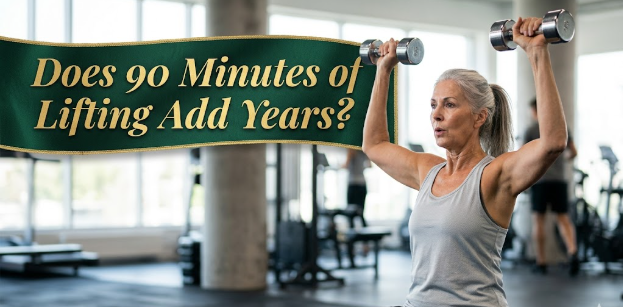
The study that crossed my desk earlier this month stopped me mid-scroll. Not because it confirmed what I’ve spent 28 years believing, but because it quantified it at a scale I hadn’t seen before.
Thirty years of data. Nearly 150,000 adults. Three long-running cohort studies coordinated through Harvard T.H. Chan School of Public Health. Researchers tracked weekly resistance training hours and followed participants to see how long they lived. And the number that emerged from all of that wasn’t 5 hours a week. It wasn’t even 3. It was 90 to 120 minutes.
One session and a half. Two focused workouts a week.
The mortality outcomes attached to that number are significant enough that every serious person in the fitness space needs to sit with them for a moment.
1. What the Harvard Data Actually Found
The study, published in June 2026 in the British Journal of Sports Medicine, compared people who did varying amounts of weekly resistance training. Adults averaging 90 to 120 minutes a week had a 13% lower risk of dying from any cause compared to those doing none. A 19% lower risk of dying from cardiovascular disease. And a 27% lower risk of dying from neurological conditions, Alzheimer’s included.
That last figure is the one worth pausing on. The heart data wasn’t new territory. The Alzheimer’s association is a different conversation entirely, and it shifts how we should be talking about strength training to clients in their 40s and 50s.
The researchers, led by Yiwen Zhang and corresponding author Dr. Edward Giovannucci, professor of nutrition and epidemiology at Harvard Chan, also found that going beyond 120 minutes per week provided no additional protection against premature death. The benefit curve flattened. More training simply stopped buying more years.
So if you’re currently lifting three hours a week and telling yourself it’s for longevity reasons, the data doesn’t support that framing. Performance, body composition, and sports-specific capacity are different goals, and more volume can serve those. But the longevity benefit appears to be fully captured at 90 to 120 minutes.
The study also looked at combined training. Participants who did both resistance and aerobic work had among the lowest mortality risks in the entire dataset, up to 45% lower than those doing neither. These two modalities don’t compete for your schedule. They reinforce each other.

2. The Myth That More Volume Equals More Benefit
This is the single most consistent mistake I’ve observed across nearly three decades in the fitness industry: the assumption that if some is good, more must be better.
It’s not an irrational assumption. Fitness culture has fed it aggressively. More sessions. More sets. More load. The implicit message in most gym environments is that the person doing five days a week is doing it right and the person doing two days is cutting corners.
The dose-response curve on longevity says something different.
There’s a meaningful volume zone, and within that zone the mortality benefits accumulate. Outside it, they stop accumulating. This doesn’t mean extra training is harmful. The Harvard data didn’t suggest that. It means the extra sessions aren’t extending your life beyond what 90 focused minutes was already doing for you.
That’s a distinction worth making clearly, because a lot of people have structured their entire training week around volume, when the longevity target was achievable in a fraction of the time they’re investing.
But volume isn’t the only thing people get wrong. The quality of those 90 minutes is equally misunderstood, and I’ll come back to that.
3. What Resistance Training Is Actually Doing to Your Biology
The mortality statistics make the argument at a population level. The cellular data makes it personally.
A 2024 study published in MDPI Biology analyzed telomere length across 4,814 US adults and looked at how resistance training correlated with biological aging. Telomeres are the protective caps on chromosomes that shorten as we age. Their length is one of the more reliable markers of cellular age available to researchers. The study found that people doing approximately 90 minutes of resistance training per week had telomeres biologically younger by about 3.6 years compared to non-trainers.
Not marginal. Not statistical noise. Three and a half years of cellular age difference, attached to a weekly training habit that takes less time than most people spend on email.
The mechanisms behind both the telomere finding and the mortality data aren’t hard to trace. Resistance training improves insulin sensitivity, which has downstream effects on inflammation and metabolic damage accumulation. It preserves and builds skeletal muscle mass. Some data suggests low muscle mass in older adults correlates with roughly a 30% higher mortality risk. There are also well-documented cardiovascular adaptations from resistance training that don’t require aerobic exercise to produce.
The neurological piece is the one that interests me most. Strength training appears to stimulate production of brain-derived neurotrophic factor, a protein involved in neuron survival and growth. That’s likely part of the mechanism behind the Alzheimer’s risk reduction the Harvard team observed. The brain is not separate from the training response. It’s very much part of it.
None of this requires five days a week to activate. Two sessions. The biology doesn’t ask for more than that to produce these effects.
At fitnessupdates.org, we cover research across the health and fitness spectrum, and this is one of the more clinically grounded findings we’ve seen in recent years on the training-longevity question. The signal is consistent across different study designs.
4. Where People Consistently Go Wrong
There are patterns here. Predictable ones. And they show up regardless of whether someone is 30 years into fitness or just starting.
The first is unsustainable high-volume training. Someone commits to five sessions a week, burns out or picks up a nagging injury in week four, then does nothing for two months. When you average the output across that quarter, the weekly resistance training total looks miserable. A sustainable 90 minutes every single week, for years, produces far better outcomes than 300 minutes weekly that stops and starts every few months.
If you’ve been fighting this pattern, why skipping rest days makes your progress worse is worth the read. The recovery piece is not optional. Adaptation happens between sessions, not during them.
The second error is treating resistance and aerobic training as an either/or decision. Some people choose lifting because they prefer it and quietly drop cardio altogether. The combined training data from the Harvard study is clear: the mortality benefit increases substantially when both modalities are present. The question of whether cardio or lifting is better for burning stubborn fat gets asked a lot, but for longevity the answer is both, at appropriate doses.
Third: mistaking time in the gym for quality stimulus. People log 90 minutes but spend a third of it resting too long between sets, moving through exercises they adapted to six months ago, doing movements that don’t sufficiently challenge any major muscle group. The studies are tracking resistance training, not gym attendance. There’s a real difference.
A quick reference for how volume maps to outcomes based on the available evidence:
| Weekly Resistance Training Volume | Mortality Outcome |
|---|---|
| 0 minutes | Baseline, no protection |
| 1 to 29 minutes | Measurable but partial mortality benefit |
| 30 to 89 minutes | Increasing benefit as volume rises |
| 90 to 120 minutes | Peak longevity zone: 13% lower all-cause mortality |
| Over 120 minutes | No additional longevity benefit observed |
| 90 to 120 min plus aerobic activity | Up to 45% lower mortality risk vs. doing neither |
That table is doing a lot of work. The difference between 1 to 29 minutes and zero is already meaningful. Starting matters more than starting perfectly.

5. How to Actually Structure the 90-Minute Target
The implementation is not complex. Two 45-minute sessions covers the zone. Three 30-minute sessions gets there too. Two 60-minute sessions with warmup time still sit inside the evidence-supported range. The split matters far less than the weekly total and the consistency with which you hit it.
What should go into those sessions? Compound movements, primarily. Squats, deadlifts, rows, pressing variations. Multi-joint exercises that recruit large amounts of muscle mass simultaneously drive the systemic adaptations the telomere research and mortality studies are capturing. Isolation work has its place but it’s not producing the longevity signal.
For people training without equipment, bodyweight movements counted explicitly in the Harvard data, which included pushups, lunges, and squats in its definition of resistance training. Seven bodyweight moves that work without any equipment covers functional options if that’s your current context.
Progressive overload still matters. The sessions need to increase in difficulty over time, whether through load, volume, or reduced rest. If what you’re doing in month six looks identical to month one, the adaptive signal has likely faded and you’re maintaining rather than improving.
One note on aerobic pairing. The mortality data improves considerably when resistance training runs alongside regular aerobic activity. It doesn’t need to be high intensity. Walking, cycling, swimming, even recreational sports. The point is that cardiovascular stimulus operates through different pathways than resistance training, and both pathways appear to contribute to lifespan independently. Stacking them is the most well-supported approach.
The Harvard team were careful to note the observational nature of their data. Causality can’t be fully isolated. People who strength train may make other healthy choices that contribute to their longevity. That’s a legitimate limitation to acknowledge.
But the telomere evidence adds biological plausibility. And the consistency of findings across decades and multiple large cohorts is harder to wave away than a single study. There’s something real happening at 90 minutes per week that the data keeps returning to.
For most people reading this, 90 minutes is achievable. Two sessions, planned in advance, treated as non-negotiable appointments. That’s the structure the evidence points toward. Not heroic. Not complicated. Just consistent, over time, at a meaningful intensity.
If you want a broader view of what sustained training actually does to your body’s systems over months and years, what happens to your body when you exercise every day covers the physiological picture in more detail.
And if you’re tracking your progress and wondering whether your current routine is still delivering the stimulus it should, fitnessupdates.org has practical resources on evaluating and adjusting training programs over time.
Frequently Asked Questions
Does it matter if I split the 90 minutes across many short sessions rather than two longer ones?
The Harvard study tracked total weekly minutes rather than individual session structure. Three 30-minute sessions, two 45-minute sessions, six 15-minute sessions — any combination reaching 90 minutes weekly appears to generate the same mortality benefit. What the research doesn’t tell us is whether extremely fragmented sessions of under 10 minutes maintain the same signal. Practically speaking, keeping sessions at 20 minutes or longer is sensible.
Can resistance bands or bodyweight exercises count toward the 90-minute target, or does this only apply to barbell training?
The Harvard data explicitly included bodyweight activities like pushups, lunges, and squats in its resistance training category. The MDPI telomere study similarly used a broad definition. You don’t need barbells, gym membership, or specialized equipment to hit the evidence-supported threshold. The movements need to provide meaningful muscular challenge, which progressed bodyweight exercises do.
Should people over 65 approach the 90-minute target differently?
The benefit appeared across age groups in the Harvard cohort data. Older adults may need longer recovery periods between sessions and should prioritize joint-friendly movement patterns and technical precision over load. But the 90-minute weekly target remains a reasonable reference point. Given the Alzheimer’s risk reduction finding specifically, the case for consistent resistance training actually becomes more compelling with age rather than less.
What happens to the longevity benefit if I add cardio to my 90 minutes of weekly lifting?
It improves substantially. The combined training group had up to 45% lower mortality risk than those doing neither. Aerobic and resistance training appear to work through different biological pathways and complement each other. Even adding moderate walking or cycling alongside your resistance sessions captures the combined benefit. There’s no tradeoff here.
Does the type of resistance training matter? Is a barbell program more effective than machines for these outcomes?
The studies did not break down outcomes by equipment type with enough resolution to make strong recommendations here. What mattered was that the activity involved meaningful muscular resistance. Free weights, machines, cable systems, resistance bands, and bodyweight progressions all likely contribute to the mortality benefit. The more relevant variable across all of them is progressive overload over time, making sessions increasingly challenging relative to the individual’s capacity.
The full study from Harvard T.H. Chan School of Public Health, published in the British Journal of Sports Medicine in June 2026, is available at https://hsph.harvard.edu/news/moderate-amount-of-strength-training-each-week-could-boost-longevity/.