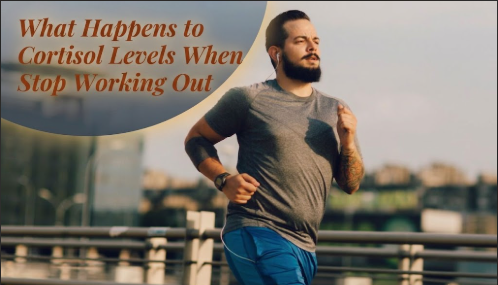
What Happens to Cortisol Levels When You Stop Working Out
Stopping exercise is not the same as reducing stress. Those are two different things, and the body does not confuse them.
I’ve had this conversation more times than I can count across 28 years in the fitness industry. Someone takes a break because of an injury, a demanding work stretch, a family situation. They come back four or five weeks later and report something they weren’t expecting: worse sleep, noticeable irritability, a midsection that looks different despite not eating more, a general sense of being wired and flat at the same time. They’ve been resting. By every conventional measure, they should feel better. But they don’t.
What’s happening, in most cases, is cortisol dysregulation. And understanding why requires looking at what exercise actually does to cortisol in the first place, because the common understanding is almost entirely backwards.
- What Exercise Actually Does to Your Cortisol Levels
Most people assume exercise raises cortisol and rest lowers it. That’s partially correct and mostly misleading.
Yes, cortisol rises significantly during training. A hard conditioning session or a heavy compound lifting block can push cortisol levels 50 to 100 percent above resting baseline. That’s not a problem. It’s one of the primary mechanisms through which training produces its adaptations. That acute spike mobilizes stored fuel, supports immune function, and primes tissue for repair. And once the session ends, cortisol doesn’t simply return to baseline. It typically drops below it during the recovery window. That post-exercise dip is where much of the long-term benefit lives.
Consistent training also calibrates the hypothalamic-pituitary-adrenal axis, the HPA axis, to function more efficiently. Over time, a trained individual produces a more measured cortisol response to both physical and psychological stressors. The spikes become more proportionate. The recovery period shortens. The overall resting baseline tends to sit lower than in sedentary individuals of comparable age and health status.
This is one of the most underappreciated effects of regular exercise. It isn’t only burning calories or building lean tissue. It’s actively regulating the body’s stress response system at a hormonal level, training the HPA axis the same way progressive overload trains the musculoskeletal system. When training disappears, that regulatory calibration doesn’t hold in place. It begins to drift.

- The Cortisol Timeline After You Stop Training
The changes that follow a training cessation don’t hit all at once. They’re gradual, which is exactly why most people don’t connect what they’re experiencing to the absence of exercise.
TimeframeWhat’s Happening with CortisolDays 1-7Workout-induced cortisol spikes are absent. Resting baseline feels calm. No major change yet in systemic regulation.Weeks 2-3The HPA regulatory effect of consistent training begins to fade. Resting cortisol starts to creep upward, particularly in response to everyday stressors.Week 3-4Sleep quality often deteriorates. Cortisol and sleep have a bidirectional relationship, so as sleep quality drops, cortisol climbs further.Months 1-2Insulin sensitivity declines. Visceral fat accumulation can begin even without significant changes in caloric intake.Months 3+HPA dysregulation becomes more entrenched. The system is progressively less equipped to manage ordinary physiological and psychological stressors.
The first week is often deceptively quiet. The nervous system interprets the absence of acute training stress as relief. But that initial calm doesn’t mean the cortisol system is settling into something healthy. It means it hasn’t yet registered what’s missing.
By weeks three to four, the absence of training becomes physiologically significant. Most people aren’t tracking cortisol during this window, so they attribute the irritability, the disrupted sleep, the changed appetite patterns, to other things. Work pressure. Season change. Getting older. The connection to the gap in training is almost never made, and that misattribution means the actual problem never gets addressed.
- The Sleep-Cortisol Loop That Compounds Everything
This is where things tend to get worse faster, and it’s a mechanism that most general fitness content skips past entirely.
Exercise is one of the most consistent drivers of sleep quality we know of. It improves sleep onset latency, increases the proportion of slow-wave deep sleep, reduces nighttime cortisol elevation, and helps stabilize the natural circadian cortisol rhythm. In a well-regulated system, cortisol should peak in the early morning hours and drop to its lowest point around midnight. Exercise anchors that rhythm. Without it, the curve begins to flatten or, in some people, partially invert.
Poor sleep elevates cortisol. Elevated cortisol disrupts sleep. Once that cycle starts, it’s difficult to break without reintroducing the stimulus that was regulating it.
If you’ve gone through a period without training and found yourself lying awake at 1 or 2 a.m. with your thoughts running faster than they should, this is likely part of what’s happening. It’s not stress in isolation. It’s a physiological loop that exercise was previously preventing.
And there’s a body composition consequence here that people rarely anticipate. Cortisol has direct receptor activity in visceral adipose tissue, specifically the fat that accumulates around the abdominal organs. Chronically elevated cortisol promotes lipogenesis in those cells and also increases appetite through its effects on ghrelin and neuropeptide Y signaling. People who stop training often report body composition shifts that aren’t explained by the calorie math. This is frequently why. The sleep health resource on this site covers the mechanistic side of sleep and cortisol regulation in considerably more depth if you want to work on that alongside returning to training.
- Where People Get This Completely Wrong
The most common error is treating rest and recovery as the same thing. They’re not.
Recovery from training happens during rest. But recovery from chronic, unmanaged stress requires exercise. Taking a break from the gym during a high-stress period feels intuitively reasonable. You’re overwhelmed, you’re tired, you’re adding training to a system that’s already under pressure. The problem is that removing exercise from that system doesn’t reduce the load. It removes the most reliable tool available for processing it.
I’ve watched this pattern play out across hundreds of people who’ve come through programs, gyms, and conversations over the years. The ones who stop training during stressful periods almost universally report that things got harder rather than easier after the first week or two. They interpret that as further evidence they needed more rest. What they actually needed was a recalibrated training approach, lower volume, lower intensity, more predictable scheduling, but not an elimination.
Second error: treating workout-induced cortisol as something to be minimized. I see this framing a lot in certain corners of wellness content. The cortisol that rises acutely during a training session is not the cortisol that causes problems. Chronic baseline elevation is the issue. Acute exercise-induced cortisol is precisely the mechanism through which the HPA axis learns to regulate stress more efficiently. Treating it like a threat produces interventions that make things worse, not better.
The third mistake is assuming lifestyle modifications alone can substitute for exercise on the cortisol-regulation front. Breathwork helps. Meditation helps. Cold exposure, adequate nutrition, consistent sleep timing, all of these have real and measurable effects. But none of them replicate the specific effect exercise has on HPA axis calibration. They’re tools that work in conjunction with training. If you’re interested in what lifestyle-level changes actually contribute to stress regulation, this breakdown on reducing stress through lifestyle habits is worth reading, but the underlying point stands: those strategies reach their ceiling quickly when exercise is absent.
A fourth thing, and this one is more specific. People in detraining often report that they feel wired but exhausted simultaneously, high energy mid-afternoon that won’t convert into productive output, followed by a crash in the evening right when they need to wind down for sleep. That’s a cortisol rhythm problem. The typical circadian peak-and-drop pattern has flattened, so they’re getting cortisol activity at the wrong times. Exercise, through its effect on circadian entrainment, helps keep that curve where it should be.

- What to Do During a Forced Break
If injury or circumstance has genuinely taken training off the table, the goal is damage limitation, not perfection.
Movement still counts. Walking 30 to 45 minutes at a moderate pace daily produces meaningful cortisol-regulatory effects. Not equivalent to structured training, but substantially better than complete sedentary rest. Upper-body-only training, pool work, mobility sessions, these all preserve some degree of HPA engagement. The nervous system responds to movement patterns broadly. The gym is a venue, not the mechanism.
Nutrition quality becomes more important during training gaps. Cortisol and blood glucose regulation are tightly linked, and without the insulin-sensitizing effect of consistent exercise, dietary choices carry more metabolic weight than usual. Adequate protein intake, somewhere in the range of 1.6 to 2.2 grams per kilogram of body weight, helps preserve lean mass during reduced-activity periods, which has its own downstream effects on hormonal and metabolic function. This nutrition update on fitnessupdates.org covers the practical application of that in the context of general health goals.
Sleep quality should become the primary recovery priority when training is unavailable. Keeping consistent wake times regardless of how the previous night went, getting 10 to 20 minutes of morning daylight exposure, and reducing screen stimulation in the 90 minutes before bed all help maintain the cortisol circadian rhythm. It won’t fully compensate for the loss of training, but it slows the drift considerably.
On the mental health side, and I think this deserves more direct acknowledgment than it usually gets. Cortisol dysregulation from detraining affects mood through mechanisms beyond simple stress. Exercise has direct effects on dopamine turnover, serotonin availability, and BDNF production, brain-derived neurotrophic factor, which plays a role in cognitive function and emotional regulation. When those pathways are disrupted by a training gap, the mood changes people experience aren’t psychosomatic. They’re physiological. Understanding that can make a difficult stretch somewhat easier to manage. There’s relevant coverage on the mood and hormonal side of this in the mental health section here.
When you do return to training, the cortisol-regulating benefit restores relatively quickly. Two to three weeks of consistent moderate training is enough to begin seeing meaningful recalibration of resting cortisol, sleep quality, and HPA responsiveness. The body doesn’t hold a grudge. But it does require consistency to hold the benefit once it’s restored.
The body is not designed for sustained inactivity. Cortisol is one of the clearest ways it communicates that.
Frequently Asked Questions
How quickly do cortisol levels change after stopping exercise?
The first week typically shows minimal change to resting baseline cortisol, since the acute workout-induced spikes simply stop occurring. The more significant shift begins around weeks two to four, when the HPA regulatory effect of consistent training starts to diminish and resting cortisol begins climbing. In individuals who were training four or more times per week prior to stopping, this shift can be measurable within 10 to 14 days.
Can elevated cortisol from detraining cause fat gain on its own?
Cortisol doesn’t operate in isolation, but it’s a significant contributor to the body composition changes that follow training cessation. Chronically elevated baseline cortisol promotes visceral fat accumulation through direct receptor activity in abdominal adipose tissue, and it also increases appetite via ghrelin and neuropeptide Y signaling. The combination of that hormonal shift with a caloric intake that hasn’t adjusted to reduced energy expenditure explains why detraining body composition changes are often disproportionate to what simple calorie math would predict.
Does the type of exercise matter for cortisol regulation?
Yes, but probably less than most people assume. Both cardiovascular and resistance training produce the acute cortisol spike-and-recovery cycle that calibrates the HPA axis. High-intensity interval training tends to produce the largest acute cortisol responses, but the regulatory benefit is fairly consistent across training modalities as long as the intensity is sufficient to constitute a genuine physiological stress. Gentle yoga or casual walking produces some benefit but doesn’t fully replicate the HPA calibration effect of moderate-to-vigorous structured exercise.
Is there a meaningful difference between one week off and six weeks off?
Significantly. One week off, particularly for a consistently trained individual, is unlikely to produce measurable HPA dysregulation. The system has enough residual calibration to hold. Six weeks is a different situation entirely. By that point, HPA adaptations have measurably diminished, the sleep-cortisol rhythm has often drifted, and insulin sensitivity has declined. The practical implication is that planned deload weeks are physiologically distinct from extended training gaps and shouldn’t be treated as equivalent.
Should someone reduce exercise intensity during high-stress life periods to protect cortisol levels?
Reducing volume and intensity is usually sensible during acute high-stress periods, but eliminating training altogether is almost never the right call. For most people, exercise remains net-positive for cortisol regulation even under elevated life stress. The concern about stacked stressors is legitimate at extreme training volumes, but the appropriate response is adjustment, not cessation. Dropping from five sessions per week to two or three moderate sessions preserves the majority of the cortisol regulatory benefit while reducing total physiological load.