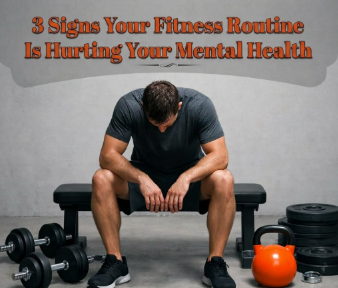
3 Signs Your Fitness Routine Is Hurting Your Mental Health
One of the most persistent beliefs I’ve encountered across nearly three decades in this industry is that exercise is always good for your mental health. Always. No asterisks. No nuance required. And I understand where that belief comes from. The research linking physical activity to improved mood, reduced anxiety, and better cognitive function is genuinely robust. But that same belief makes it very difficult for people to recognise when the training they’re doing is actually making things worse.
Through conversations on the Escape Your Limits podcast, and years of working with trainers, coaches, and fitness professionals across every kind of facility, I’ve seen a pattern that doesn’t get enough attention. Someone is training consistently, sleeping roughly, showing up every day, and yet they’re more anxious than they were six months ago. More irritable. Tired in a way that a long weekend doesn’t fix.
The confusion makes sense. But conflating physical effort with mental wellness is a real mistake, and the fitness industry, broadly speaking, is still not good at acknowledging it.
These are the three signs I’ve come to recognise.
- You Feel Guiltier After Missing a Workout Than You Did Before You Started Training
There’s a version of this that’s completely normal. You’ve built a routine, your body has adapted to movement, and if you skip a session you feel a bit flat, maybe slightly restless. That’s just physiology. That’s your nervous system missing a pattern it’s been conditioned to expect.
But there’s a different version. The person who misses a Saturday run and spends the rest of the weekend mentally punishing themselves for it. Who compares every week against some idealised training schedule, and any deviation reads as a personal failure. Who doesn’t feel disappointment when life gets in the way of training. They feel shame.
That’s not motivation. That’s anxiety with a gym membership.
When exercise becomes tied to self-worth rather than self-care, the psychological toll is real and measurable. Research into what’s termed exercise dependence or compulsive exercise shows that the underlying mechanisms closely resemble other behavioural cycles where the person experiences relief when they comply with the behaviour and genuine distress when they can’t. It’s the distress side of that equation that matters here. Distress is not dedication. It’s a signal that something in the relationship with training has gone off track.
The wrong belief is that the guilt means you care about your health. And I understand why people interpret it that way. But genuine care for your body doesn’t feel like punishment. It feels like respect for what your body actually needs, including rest, imperfect weeks, and the occasional unplanned day off that doesn’t require a lengthy internal justification.
If you want a healthier framework for building consistency without the mental weight, the mental health updates for inner peace on fitnessupdates.org is worth reading alongside this.

- Your Mood Depends Entirely on Whether You Trained That Day
This one gets missed because it looks like the exercise is working.
If you had a good session, you feel like yourself. Clear, calm, capable. If you didn’t train, or if the session was flat, there’s a kind of grey quality to the day. Not depression, exactly. More like the day is running on a lower setting. And the only thing that really reliably brings it back is the next workout.
Look, exercise does improve mood. The neurochemical picture is well established. Beta-endorphins, effects on serotonin and dopamine regulation, and reduced cortisol under moderate training loads. Noticing you feel better after a workout isn’t a sign something is wrong. But when the workout becomes the only reliable way to regulate how you feel emotionally, that’s worth examining honestly.
What tends to happen, and I’ve seen this in a lot of people who would describe themselves as fitness-focused, is that training gradually starts to function as emotional avoidance. Not deliberately. Not consciously. But the habit of “I feel stressed, I’ll train harder” can become so ingrained that the actual source of the stress never gets real attention. The training becomes a lid, not a resolution. The pressure sits underneath, and it builds.
I wrote about this briefly on a recent fitnessupdates.org piece on lifestyle health updates for stress reduction, and one of the consistent threads across that research is that single-tool approaches to emotional wellbeing create fragility. If you have only one reliable way to feel okay, what happens when that tool is taken away? Injury, illness, a run of poor sleep, a month of travel. Suddenly there’s nothing else in the toolkit.
People dealing with anxiety in particular often use physical training to burn off nervous energy rather than addressing what’s generating it. Short-term, that works. Longer-term, the workouts tend to need escalating to have the same effect, and the baseline anxiety is still sitting there, unchanged.
If this pattern sounds familiar, the answer isn’t to stop training. It’s to start building the other tools alongside it. Quality sleep, genuine rest, social connection, time that isn’t structured or productive. Exercise does its best work as part of a full range of approaches, not as a substitute for all of them.
- You’re Training Harder and More Often, but Your Mental State Is Getting Worse
This is the sign that gets dismissed most readily, because from the outside it looks like the opposite of a problem.
More training, better results. That’s the model. And it holds, up to a point. But the relationship between training volume and wellbeing isn’t a straight line. It curves. Go past the threshold for your individual recovery capacity and the curve turns back on you.
The physiological explanation matters here. Heavy training loads, particularly without adequate recovery, produce chronically elevated cortisol. Cortisol was designed for short-duration stress responses, not sustained elevation across days and weeks of accumulation. When cortisol stays elevated persistently, it suppresses function in the prefrontal cortex, the part of the brain managing rational thinking and emotional regulation, while increasing reactivity in the amygdala. What you get neurologically is a brain that is more irritable, quicker to perceive threat, and less capable of putting things in perspective.
So the person training six days a week who’s snapping at people they care about, sleeping poorly despite being exhausted, and feeling a vague but persistent sense of unease, who’s attributing all of that to external stress at work or at home, may be looking in the wrong direction entirely. The training load itself is the stressor, and the brain is showing the strain.
This is what overtraining syndrome looks like when it presents psychologically, and it largely goes unrecognised because people don’t think to connect their mood to their training volume. They examine everything else first. And usually they add more training, which makes things worse.
The pattern to watch for: training frequency or intensity has increased in the past two to three months, and during that same window your mood, sleep quality, or irritability have noticeably declined. Not temporarily. Consistently. That correlation matters, and it’s more than a coincidence.
Sleep is one of the most sensitive indicators. If you’re training more and sleeping worse, that combination is one of the earliest reliable signals that the body’s recovery systems are being outrun. The sleep health updates on fitnessupdates.org covers the relationship between training load and sleep quality in detail.
Reducing volume by 25 to 30 percent and prioritising sleep and protein intake during a proper recovery block will often reverse these symptoms faster than expected. The body is genuinely good at restoring itself when you give it the conditions to do so.
- Quick Reference: The 3 Signs and What to Do About Them
Sign How It Typically Shows Up Practical First Step
Post-workout guilt Shame or mood collapse after any missed session; worth feels tied to compliance with a training schedule Examine the belief that rest equals failure; schedule deliberate rest days without compensation
Mood dependent on training Rest days feel emotionally grey or destabilising; training is the primary or only reliable mood tool Build one additional non-training recovery tool (sleep quality, social time, low-intensity outdoor activity)
More training, worse mood Irritability, poor sleep, persistent anxiety despite consistent high training output Cut training volume 25 to 30% for two to four weeks; monitor sleep quality as the primary recovery marker - The Belief the Industry Has Been Slow to Examine
Exercise is medicine. I believe that after nearly 30 years in this space. But medicine has dosage. Medicine taken in the wrong context, at the wrong intensity, or for the wrong reasons, has side effects.

The fitness industry tends to celebrate more. More volume, more output, more discipline. And that framing serves a lot of commercial interests very well. What it doesn’t always serve is the person who’s quietly struggling inside a routine that looks fine on paper.
What I’d ask anyone reading this to sit with is a fairly simple question. Not which training split is right for you, or whether you’re hitting enough protein, but this: is your relationship with exercise making you more resilient, or more dependent? Are you training for vitality, or training to manage a feeling you haven’t quite named yet?
Those questions tend to lead somewhere more useful than any programme change. And if the honest answer is closer to the second option, there are some genuinely practical mental health updates for anxiety on fitnessupdates.org that are worth working through alongside your training routine.
That’s usually where the real progress starts.
Frequently Asked Questions
Can exercise actually cause anxiety to get worse?
Yes, it can. High-volume or high-intensity training without adequate recovery leads to chronically elevated cortisol. Sustained cortisol elevation affects the brain’s emotional regulation systems, increasing reactivity in the threat-response areas while reducing function in the areas responsible for perspective and rational thought. This is particularly noticeable in people who are already carrying significant stress in other areas of their lives, where training adds to the total load rather than offsetting it.
How do I know if I’m doing too much?
Persistent irritability, sleep that doesn’t restore you, and a consistent mood decline over several weeks are the clearest signals. Compare those against your training log. If volume or intensity has increased during the same period, that correlation is worth taking seriously. A sustained drop in motivation, specifically around training you used to enjoy, is another reliable indicator that recovery is losing the race against load.
What’s the difference between normal training fatigue and something worth addressing?
Normal fatigue resolves within 24 to 48 hours and doesn’t significantly alter your mood or your outlook. When fatigue is persistent across consecutive rest days, when it’s accompanied by irritability or emotional flatness, and when it doesn’t meaningfully improve with rest, that’s the pattern that warrants attention. The combination of physical tiredness and psychological symptoms together is the key distinction.
Is it okay to use exercise as a way to manage stress?
Absolutely, within reason. Exercise is a genuinely effective tool for acute stress management and for building general stress resilience over time. The issue arises when it becomes the only tool, particularly when it’s being used to suppress emotional stress rather than process it. A mix of approaches, including rest, genuine recovery, social connection, and professional support where needed, tends to produce more stable and lasting results than training alone.
At what point should I talk to someone about this?
If any of these patterns are noticeably affecting your quality of life or your relationships, talking to a professional is worth doing. A sports psychologist or therapist familiar with exercise-related psychological issues can be very helpful. It’s also worth checking with a doctor, because hormonal imbalances and thyroid dysfunction can produce symptoms that closely resemble psychological overtraining, and ruling those out first makes sense.