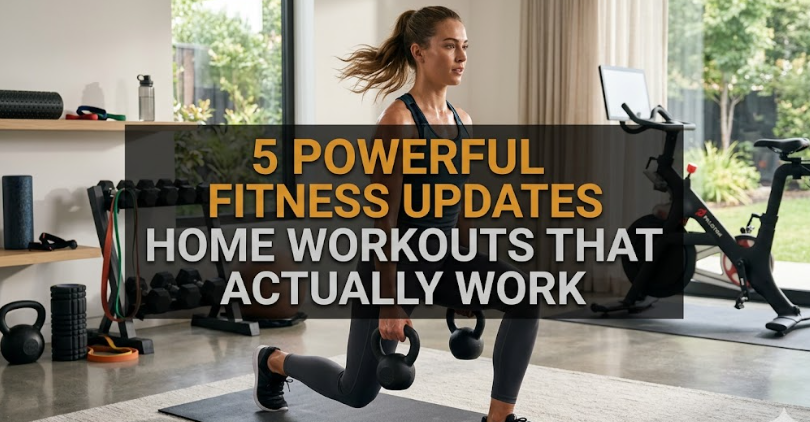

5 powerful fitness updates home workouts that actually work
There was a time when “working out at home” meant a couple of random push-ups, maybe a skipped rope session, and a promise to start something serious next Monday. But things have changed—quietly, steadily, and in ways most people didn’t even notice. Home workouts are no longer a backup plan. They’ve evolved into a legitimate, science-backed, and surprisingly effective path to real fitness.
This isn’t about doing more. It’s about doing smarter.
In this piece, you’ll explore five powerful updates in home workouts that actually deliver results—not just in theory, but in real life. These aren’t trendy hacks or viral challenges. They’re practical shifts in how people approach fitness at home, rooted in consistency, efficiency, and a deeper understanding of how the body responds to movement.
Along the way, you’ll find examples, small routines, thought patterns, and even mistakes that quietly sabotage progress. Think of this less as an article and more like a guided conversation—one that helps you rethink how you train, even if your “gym” is just a corner of your room.
update one: micro-workouts that stack up over time
Let’s start with something that might feel counterintuitive.
You don’t need a full hour.
In fact, one of the most effective changes in home fitness is the rise of micro-workouts—short bursts of intentional movement scattered throughout the day. These sessions can be as short as 5 to 10 minutes, but when done consistently, they build momentum in a way long workouts often fail to.
Picture this: instead of waiting for the perfect 60-minute window (which rarely comes), you do three 10-minute sessions—one in the morning, one midday, one in the evening. Suddenly, you’ve accumulated 30 minutes of focused effort without feeling overwhelmed.
What makes this powerful isn’t just time efficiency. It’s psychological.
Short workouts remove resistance. You don’t need motivation—you just need to start. And once you start, something interesting happens: you often do more than planned.
A simple micro-workout example:
- 10 squats
- 10 push-ups (or wall push-ups)
- 20-second plank
- repeat 3 times
That’s it. No equipment, no setup, no excuses.
Over weeks, these “small” sessions begin to rewire your routine. Movement becomes part of your day, not a separate task you have to schedule.
The real magic? Consistency beats intensity.
update two: tempo training for maximum impact
Most people rush through exercises. Fast push-ups, quick squats, rapid lunges—done in a blur. It feels productive, but often it’s just momentum doing the work.
Tempo training flips this completely.
Instead of focusing on how many reps you do, it focuses on how you do them. Slowing down each movement increases muscle tension, improves control, and turns even basic exercises into something far more challenging.
Try this with a squat:
- lower down for 4 seconds
- pause for 1 second at the bottom
- rise up in 2 seconds
Suddenly, 10 squats feel like 30.
This approach works especially well for home workouts where equipment is limited. You don’t need heavier weights if you can make your bodyweight feel heavier.
There’s also a deeper benefit: awareness.
When you slow down, you start to notice things—imbalance between legs, posture issues, weak points. You stop “doing exercises” and start understanding your body.
That awareness carries into everything else you do, from lifting groceries to sitting at your desk.
update three: hybrid cardio-strength routines
For years, people separated cardio and strength training like they were two different worlds. One day for running, another for lifting. At home, this often meant choosing one and neglecting the other.
The modern approach blends both.
Hybrid workouts combine strength exercises with short bursts of cardio, creating sessions that build muscle and improve endurance at the same time.
Here’s a simple example:
- 12 squats
- 10 push-ups
- 30 seconds jumping jacks
- 20-second rest
- repeat for 4 rounds
This kind of routine keeps your heart rate elevated while still challenging your muscles. It’s efficient, dynamic, and—perhaps most importantly—less boring.
But there’s a hidden advantage here: adaptability.
You can adjust intensity easily. Feeling low energy? Slow it down. Feeling strong? Add jumps, shorten rest, increase rounds.
This flexibility makes it easier to stick with the routine long-term, which is where real results come from.
update four: the rise of mobility as a core workout
Mobility used to be an afterthought—a quick stretch at the end of a workout, often skipped entirely.
Now, it’s becoming a central focus.
Why? Because people are starting to realize that strength without mobility is limited. Tight hips, stiff shoulders, and restricted movement patterns don’t just affect performance—they increase the risk of injury.
At home, where many people spend long hours sitting, mobility work becomes even more important.
A basic mobility flow might include:
- hip circles
- cat-cow stretches
- deep squat holds
- arm rotations
It doesn’t look intense. It doesn’t feel like a “workout” in the traditional sense. But over time, it transforms how your body moves.
You begin to squat deeper, reach higher, move smoother.
And something unexpected happens: other workouts become easier. Your form improves. You feel less pain. Recovery speeds up.
Mobility isn’t just preparation—it’s progression.
update five: habit-based training instead of goal-based pressure
This might be the most important update of all.
Traditional fitness advice often revolves around goals: lose 10 kg, gain muscle, get abs. While goals can be motivating, they can also create pressure—and when results are slow (as they usually are), that pressure turns into frustration.
The newer approach shifts focus to habits.
Instead of asking, “Did I hit my goal?” you ask, “Did I show up today?”
This sounds simple, but it changes everything.
When your identity becomes someone who trains regularly—even in small ways—you remove the emotional rollercoaster of success and failure. You’re no longer starting over every Monday.
You’re just continuing.
A habit-based approach might look like:
- committing to 10 minutes daily, no matter what
- linking workouts to existing routines (after brushing teeth, before dinner)
- tracking consistency, not performance
Over time, these habits compound.
And ironically, this is what leads to the very goals people were chasing in the first place.
bringing it all together: a sample weekly structure
To make these ideas practical, here’s how you could structure a simple home workout week using all five updates:
monday
micro-workouts + tempo squats and push-ups
tuesday
hybrid cardio-strength routine (short, intense)
wednesday
mobility-focused session (15–20 minutes)
thursday
micro-workouts throughout the day
friday
tempo training full-body session
saturday
light hybrid workout or active movement (walking, stretching)
sunday
rest or gentle mobility
This isn’t rigid. It’s a framework you can adjust based on your energy, schedule, and progress.
The key is not perfection—it’s continuity.
real-life reflections: what people often get wrong
Even with the best strategies, there are patterns that quietly hold people back.
One common mistake is overcomplicating things. Fancy routines, complex plans, too many exercises—it creates friction. And friction leads to inconsistency.
Another is chasing intensity too early. Going all-out in the first week often leads to burnout in the second.
Then there’s comparison. Watching others online, measuring yourself against unrealistic standards—it drains motivation.
The truth is, effective home workouts are often simple, even repetitive. What makes them powerful is not novelty, but consistency and intention.
a small mental shift that changes everything
Instead of asking, “Is this enough?” try asking, “Can I do this again tomorrow?”
That one question filters out unsustainable routines and highlights what actually works.
Fitness isn’t built in a single session. It’s built in patterns—quiet, repeated actions that don’t always feel significant in the moment.
But over time, they reshape everything.
frequently asked questions
- can home workouts really replace the gym?
Yes, for most people, they can. With proper structure, tempo control, and consistency, home workouts can build strength, improve endurance, and support fat loss effectively. The gym offers more equipment, but results ultimately depend on how you train, not where.
- how long should a home workout be?
There’s no fixed rule. Even 10–20 minutes can be effective if done with focus and proper intensity. Micro-workouts throughout the day can also add up to significant results over time.
- do i need equipment for home workouts?
Not necessarily. Bodyweight exercises, combined with techniques like tempo training and hybrid routines, can be highly effective. However, simple tools like resistance bands or dumbbells can add variety.
- how do i stay consistent with home workouts?
Start small and build habits. Attach workouts to daily routines, keep sessions short, and focus on showing up rather than performing perfectly. Consistency grows when resistance is low.
- are home workouts good for weight loss?
Yes, especially when combined with proper nutrition. Hybrid cardio-strength routines and consistent activity levels can help burn calories and improve metabolism.
- what’s the biggest mistake beginners make?
Trying to do too much too soon. Starting with overly intense or complicated routines often leads to burnout. Simpler, sustainable approaches tend to work better in the long run.
In the end, the effectiveness of home workouts doesn’t come from secret techniques or extreme effort. It comes from understanding how small, smart changes—applied consistently—can create lasting results.
And once that clicks, the space you’re in matters far less than the way you use it.