
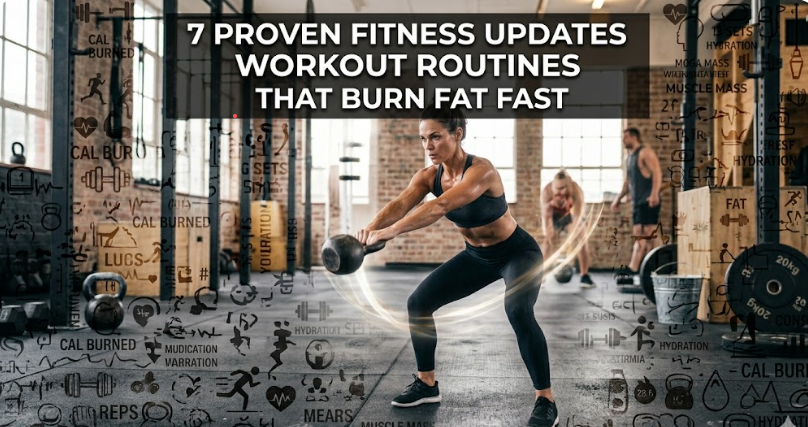

7 Proven Fitness Updates Workout Routines That Burn Fat Fast
There was a time when I believed fat loss was all about sweating more and eating less. Long treadmill sessions, random workout videos, and extreme dieting seemed like the obvious path. But over time—and through a mix of trial, frustration, and learning—I realized something important: not all workouts are created equal, and not all effort leads to results.
Fat loss is less about how long you work out and more about how intelligently you train. The body adapts quickly, which means routines must evolve. What worked a year ago might barely move the needle today. That’s where updated, research-backed workout strategies come in.
This article isn’t just a list of routines. It’s a practical, experience-driven breakdown of seven proven workout updates that genuinely accelerate fat loss. Each one has a purpose, a structure, and a reason it works.
- High-Intensity Interval Training (HIIT) with Structured Progression
HIIT isn’t new, but most people use it incorrectly. They either go too hard too soon or repeat the same intervals without progression. The real update lies in structured HIIT.
Instead of random bursts, this version uses timed intervals with progressive overload.
How it works
You alternate between short bursts of intense effort and brief recovery periods. The key difference here is progression—either increasing intensity, reducing rest time, or adding rounds over weeks.
Example routine
- 30 seconds sprint (running, cycling, or jumping)
- 60 seconds walk/rest
- Repeat 10–12 rounds
After two weeks:
- Increase sprint to 40 seconds
- Reduce rest to 50 seconds
Why it burns fat fast
HIIT triggers excess post-exercise oxygen consumption (EPOC), meaning your body continues burning calories long after the workout ends. With progression, your metabolism doesn’t adapt too quickly.
Practical insight
You don’t need to feel destroyed after every session. The best HIIT sessions leave you challenged but able to recover within a day.
- Strength Training with Short Rest Periods
Traditional weightlifting focuses on muscle gain with longer rest periods. The updated approach keeps the weights heavy but cuts down rest time to increase calorie burn.
How it works
You perform compound exercises back-to-back with minimal rest, keeping your heart rate elevated.
Example routine
- Squats: 10 reps
- Push-ups: 12 reps
- Bent-over rows: 10 reps
- Rest: 30–45 seconds
- Repeat 4–5 rounds
Why it burns fat fast
You build muscle while maintaining a cardio-like intensity. More muscle increases your resting metabolic rate, meaning you burn more calories even when doing nothing.
Practical insight
Form should never be sacrificed. If shorter rest causes sloppy technique, extend rest slightly rather than risk injury.
- Hybrid Cardio Strength Circuits
This method blends resistance training with cardio movements in a seamless flow. It feels less repetitive than traditional workouts and keeps engagement high.
How it works
You combine strength exercises with explosive cardio moves in a circuit format.
Example routine
- Dumbbell lunges: 12 reps
- Jump squats: 10 reps
- Shoulder press: 10 reps
- Mountain climbers: 30 seconds
- Repeat 4 rounds
Why it burns fat fast
It keeps your heart rate elevated while engaging multiple muscle groups. The constant switching prevents plateaus and increases overall calorie expenditure.
Practical insight
This is ideal for people who get bored easily. The variety itself becomes a motivation tool.

- Fasted Low-Intensity Cardio (Used Strategically)
Fasted cardio has been debated for years. The update is not doing it excessively, but using it strategically.
How it works
You perform low-intensity cardio (like walking or cycling) in a fasted state, typically in the morning.
Example routine
- 30–45 minutes brisk walking
- Heart rate at 50–60% of maximum
Why it burns fat fast
In a fasted state, insulin levels are low, making fat more accessible as an energy source. While the difference isn’t massive, consistency makes it effective.
Practical insight
This isn’t a replacement for intense workouts. Think of it as an addition, not the main strategy.
- Progressive Bodyweight Training
Bodyweight workouts are often underestimated. The update lies in progression and intensity, not just repetition.
How it works
You start with basic movements and gradually increase difficulty using tempo, pauses, and advanced variations.
Example routine
- Push-ups: 12 reps
- Squats: 15 reps
- Plank: 45 seconds
- Rest: 30 seconds
Progression ideas
- Slow down the movement (3–4 seconds per rep)
- Add pauses at the bottom
- Switch to single-leg or decline variations
Why it burns fat fast
Controlled movements increase time under tension, forcing muscles to work harder without needing heavy equipment.
Practical insight
When done correctly, bodyweight workouts can feel harder than gym sessions.
- Metabolic Resistance Training (MRT)
MRT is one of the most efficient fat-burning systems available today. It combines heavy lifting with minimal rest in a structured format.
How it works
You perform compound exercises in circuits using moderate to heavy weights with almost no rest.
Example routine
- Deadlifts: 8 reps
- Bench press: 8 reps
- Pull-ups: 6–8 reps
- Rest: 20–30 seconds
- Repeat 4 rounds
Why it burns fat fast
It creates a massive metabolic demand. You burn calories during the workout and for hours afterward.
Practical insight
This method is intense. It’s best used 2–3 times per week, not daily.
- Active Recovery and Movement-Based Fat Loss
This might sound counterintuitive, but rest days can accelerate fat loss when used properly.
How it works
Instead of complete rest, you stay lightly active—walking, stretching, or doing mobility work.
Example routine
- 8,000–12,000 steps per day
- 15–20 minutes stretching or yoga
Why it burns fat fast
Non-exercise activity thermogenesis (NEAT) plays a huge role in daily calorie burn. Small movements add up significantly over time.
Practical insight
Some people burn more fat through daily movement than through intense workouts alone.

Putting It All Together
The real power comes from combining these routines instead of relying on just one.
Sample weekly structure
- Monday: HIIT
- Tuesday: Strength training (short rest)
- Wednesday: Active recovery
- Thursday: Hybrid circuit
- Friday: MRT
- Saturday: Fasted cardio + light bodyweight
- Sunday: Active recovery
This structure keeps your body adapting, prevents boredom, and maximizes fat-burning potential.
Common Mistakes That Slow Fat Loss
Even the best routines fail if certain mistakes are repeated.
Doing too much cardio
More isn’t always better. Excessive cardio can lead to fatigue and muscle loss.
Ignoring recovery
Without proper recovery, your body holds onto fat as a stress response.
Lack of progression
Repeating the same workout leads to plateaus.
Poor nutrition
No workout can compensate for consistently poor eating habits.
The Mental Side of Fat Loss
One thing often overlooked is mindset. Fat loss isn’t just physical—it’s behavioral.
Consistency beats intensity.
A moderate routine followed for months is far more effective than an extreme routine abandoned in weeks.
Motivation fluctuates.
Routines should be sustainable even on low-motivation days.
Results take time.
Quick fat loss is possible, but lasting fat loss requires patience.
A Realistic Expectation
With these updated routines, noticeable changes can occur within 3–4 weeks, but significant transformation usually takes 8–12 weeks.
The goal isn’t just losing fat quickly—it’s doing it in a way that keeps it off.
FAQs
- How many times per week should I work out to burn fat fast?
Ideally, 4–6 days per week with a mix of intensity levels. Balance is more important than frequency. - Is HIIT better than steady-state cardio?
HIIT burns more calories in less time, but both have benefits. A combination of both works best. - Can I lose fat without lifting weights?
Yes, but weight training helps preserve muscle and improves long-term fat loss results. - How long should each workout be?
Most effective workouts last between 30 to 60 minutes. Intensity matters more than duration. - Do I need supplements for faster fat loss?
No. Supplements can support, but they are not necessary. Consistent training and nutrition are far more important. - What’s the fastest way to see results?
Combine structured workouts, proper nutrition, quality sleep, and consistency. There is no shortcut, only smarter approaches.
Fat loss doesn’t require extreme measures. It requires smarter updates, better structure, and consistent effort. Once you shift from random workouts to intentional training, everything changes—not just your body, but your relationship with fitness itself.