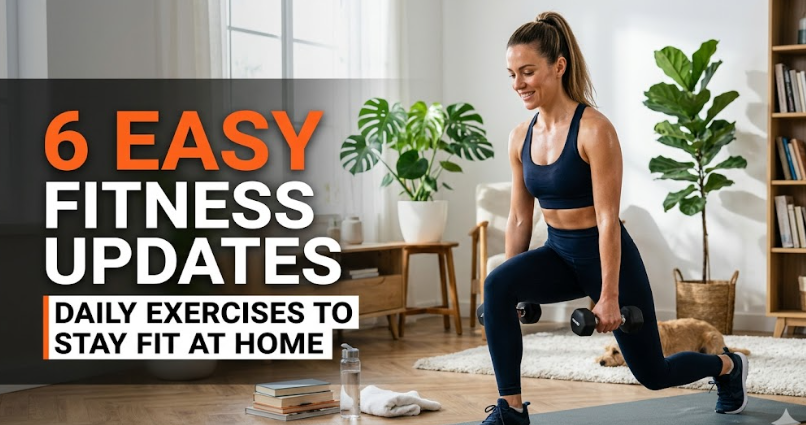

6 easy fitness updates daily exercises to stay fit at home
There was a time when staying fit felt like a complicated commitment. It meant gym memberships, strict schedules, expensive equipment, and sometimes even the pressure of being surrounded by people who seemed far more experienced. But something shifted over the years. More people began discovering that fitness doesn’t need a dedicated building or fancy machines. It can live right inside your home, quietly shaping your routine in ways that feel natural instead of forced.
What makes daily home exercise so powerful is not intensity alone, but consistency. Small, repeatable actions done every day tend to outperform occasional bursts of effort. This article walks through six easy fitness updates—simple daily exercises that fit into ordinary life without turning it upside down. Along the way, you’ll also find practical insights, mini-routines, and ways to adapt each exercise to your own pace.
Let’s begin.
- the reset stretch routine that wakes your body up
Imagine waking up and instead of rushing straight into your phone or work, you give your body five minutes of gentle movement. Not a full workout—just enough to signal your muscles that the day has started.
This first update is all about stretching, but not the static kind most people think of. It’s a flowing sequence designed to reduce stiffness and improve mobility.
A simple morning reset might look like this:
- neck rolls (slow circles, both directions)
- shoulder shrugs and arm circles
- side stretches reaching overhead
- gentle forward fold to loosen the hamstrings
- light spinal twists while standing
What makes this powerful is its subtlety. You’re not trying to burn calories here. You’re preparing your joints and muscles so the rest of your day feels easier. Over time, this reduces injury risk and improves posture.
mini habit idea:
Place your water bottle somewhere that forces you to stand and stretch before drinking. Pairing habits like this makes them stick.
reflection:
Many people skip exercise because they think it has to be intense. But a simple stretch routine done daily can transform how your body feels within weeks.
- bodyweight strength training without equipment
Strength training at home sounds intimidating until you realize your body itself is a complete gym. No weights required.
This update focuses on four core movements that cover nearly every major muscle group:
- push-ups (chest, shoulders, arms)
- squats (legs and glutes)
- planks (core stability)
- lunges (balance and leg strength)
Instead of doing them randomly, structure them into a short daily circuit:
example beginner circuit:
- 8–10 push-ups (or knee push-ups)
- 10–15 squats
- 20-second plank
- 8 lunges per leg
Repeat 2–3 times depending on your comfort level.
What makes this approach effective is progression. You don’t need to increase time drastically—just add one or two repetitions every few days.
practical insight:
If you feel too tired to complete a full routine, do half. Consistency matters more than perfection.
small upgrade:
Turn your everyday furniture into tools. A chair can help with incline push-ups or assisted squats.
- the 10-minute cardio burst
Cardio doesn’t have to mean running for miles. In fact, short bursts of activity can be just as effective when done properly.
This update introduces a 10-minute cardio routine that can fit between work tasks or during breaks.
sample routine:
- 30 seconds jumping jacks
- 30 seconds rest
- 30 seconds high knees
- 30 seconds rest
- 30 seconds mountain climbers
- 30 seconds rest
Repeat this cycle for 10 minutes.
Why this works:
Short bursts increase your heart rate quickly, improving cardiovascular health without requiring long sessions.
real-life integration:
Waiting for your food to cook? Use that time for one quick round. It turns idle time into active time.
motivation tip:
Create a simple rule—whenever you feel sluggish, do one minute of movement. Often, one minute turns into five.
- core strengthening for everyday stability
A strong core isn’t just about visible abs. It supports your spine, improves balance, and reduces back pain.
This update focuses on core exercises that are simple yet highly effective:
- plank (front and side)
- leg raises
- bicycle crunches
- dead bug exercise
quick routine:
- 20-second plank
- 10 leg raises
- 10 bicycle crunches per side
- 10 dead bug reps
Repeat twice.
what makes this unique:
These movements train your core in different ways—static (holding position) and dynamic (controlled movement).
daily life benefit:
You’ll notice improvements in posture, easier bending, and less discomfort during long sitting hours.
tiny improvement idea:
Practice engaging your core while doing everyday tasks like standing or walking. It builds awareness.
- mobility and balance training you didn’t know you needed
Most people focus on strength and cardio but ignore mobility and balance. Yet these are crucial for long-term fitness.
This update introduces simple balance and coordination exercises:
- standing on one leg (30 seconds each)
- heel-to-toe walk in a straight line
- slow controlled squats
- ankle and wrist rotations
why this matters:
Balance exercises strengthen stabilizing muscles that prevent falls and injuries.
try this:
Brush your teeth while standing on one leg. Switch halfway through.
unexpected benefit:
Improved balance enhances performance in all other exercises, making your workouts more efficient.
- the evening wind-down movement routine
Fitness isn’t only about energy—it’s also about recovery. What you do at the end of the day matters just as much as what you do in the morning.
This update focuses on calming, slow movements that help your body relax:
- deep breathing with gentle stretches
- seated forward fold
- child’s pose
- lying spinal twist
simple routine:
Spend 5–10 minutes moving slowly and breathing deeply.
why it works:
It reduces stress, improves sleep quality, and helps muscles recover.
habit stacking idea:
Do this routine right before bed or after switching off your devices.
long-term impact:
Better sleep leads to better energy, which makes daily exercise easier to maintain.

bringing it all together
Now imagine combining all six updates into your day:
morning:
- quick stretch routine
midday:
- 10-minute cardio burst
afternoon:
- bodyweight strength circuit
evening:
- core workout or balance exercises
night:
- wind-down movement
You don’t have to do everything every day. Rotate them based on your schedule. The goal is not perfection—it’s rhythm.
a simple weekly structure
day 1: strength + stretching
day 2: cardio + core
day 3: balance + stretching
day 4: strength + cardio
day 5: core + mobility
day 6: light movement + recovery
day 7: rest or gentle stretching
This keeps your body engaged without burnout.
common challenges and how to overcome them
“I don’t have time.”
Start with five minutes. Reduce friction. Once the habit forms, time naturally expands.
“I lose motivation quickly.”
Tie exercise to something you already do daily, like after brushing your teeth.
“I feel too tired.”
Ironically, light movement often increases energy. Start small and see how you feel.
“I don’t see results.”
Focus on how your body feels rather than just appearance. Strength, flexibility, and energy are all signs of progress.
the mindset shift that changes everything
Instead of thinking of exercise as a task, think of it as maintenance—like brushing your teeth. You don’t wait for problems to appear before doing it.
Fitness at home isn’t about dramatic transformations. It’s about quiet consistency. The kind that doesn’t demand attention but delivers results over time.
practical tracking method
You don’t need complex apps. Try this simple approach:
- mark an “X” on a calendar for every day you move your body
- aim to build a chain you don’t want to break
Seeing progress visually builds momentum.
final thoughts
These six easy fitness updates are not revolutionary on their own. What makes them powerful is how they fit into real life. No pressure, no extremes—just small actions repeated daily.
If you stick with even half of these consistently, your body will respond. Not overnight, but steadily.
And that steady progress is what lasts.
frequently asked questions
- how long should I exercise daily at home?
Even 15–30 minutes is enough if done consistently. Beginners can start with 10 minutes and gradually increase. - can I build muscle without weights?
Yes. Bodyweight exercises like push-ups, squats, and planks can effectively build strength when done regularly. - is it okay to exercise every day?
Yes, as long as you vary intensity. Mix light days with moderate effort to avoid burnout. - what is the best time to work out at home?
Any time that fits your schedule. Morning helps build consistency, but the best time is the one you stick to. - how soon will I see results?
You may feel more energetic within a week. Visible changes typically take 3–6 weeks depending on consistency. - do I need a strict routine to stay fit?
Not necessarily. Flexible routines that adapt to your day are often more sustainable than strict plans.
If you’d like, I can also turn this into a printable daily checklist or a weekly workout planner you can follow easily.