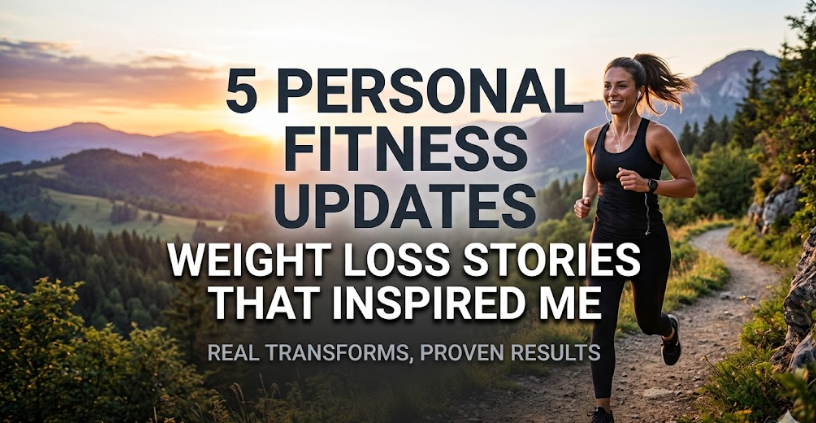

5 Personal Fitness Updates Weight Loss Stories That Inspired Me
Introduction: Why Stories Change Us More Than Advice
There is a strange moment that happens when you read someone’s transformation story. It’s quiet, almost invisible, but powerful. Suddenly the excuses sound weaker. The goals feel closer. The impossible becomes negotiable.
For years, I collected fitness tips the way some people collect bookmarks—saving everything, using almost nothing. Workouts were downloaded, diets were screenshotted, motivation videos were watched late at night and forgotten by morning. Knowledge wasn’t the problem. Action was.
Then something shifted.
Instead of hunting for perfect plans, I started paying attention to real people. Messy people. Busy people. People who failed repeatedly before they figured things out. People who didn’t wake up one morning magically disciplined.
These five personal fitness updates—five weight loss stories—changed how I think about health, discipline, and transformation. They didn’t just teach me what to do. They showed me how change actually happens.
This article is not about perfection. It’s about progress, persistence, and the quiet decisions that slowly reshape a life.
Story 1: The Man Who Started With Five Minutes
Ali never planned to lose weight.
He planned to survive his workdays.
An accountant by profession, he lived inside spreadsheets and deadlines. Twelve-hour sitting days were normal. Exercise belonged to “future life” — the imaginary chapter where everything becomes easier.
One evening, after climbing a single flight of stairs and feeling dizzy, he made a deal with himself.
Not a gym membership.
Not a diet overhaul.
Not a transformation challenge.
Just five minutes of movement per day.
That was the entire commitment.
At first, it felt ridiculous. Five minutes of walking around his apartment. Five minutes of stretching beside his bed. Five minutes of awkward jumping jacks that left him breathless.
But five minutes had a secret advantage: it was too small to resist.
Weeks passed.
Five minutes became seven.
Seven became ten.
Ten became fifteen.
Three months later, he was walking 40 minutes every morning before work. Six months later, he joined a gym—not out of guilt, but curiosity.
The most surprising change wasn’t physical. It was psychological.
He stopped negotiating with himself.
He didn’t ask, “Do I feel motivated?”
He asked, “What’s my five minutes today?”
Two years later, he had lost 32 kg.
When asked what changed his life, he didn’t mention workouts or diets.
He said:
“Starting embarrassingly small saved me.”
Lesson learned: Big changes rarely begin with big actions. They begin with actions too small to fail.
Story 2: The Mother Who Stopped Dieting Forever
Sara had been on a diet since she was sixteen.
Low-carb.
Low-fat.
No-sugar.
Juice cleanses.
Meal replacements.
She knew calorie counts the way people know phone numbers.
But every year followed the same pattern:
Lose weight → regain weight → feel worse → start again.
The turning point came unexpectedly during her daughter’s birthday party.
She noticed something strange.
Children ate cake joyfully, ran around wildly, forgot about food, and came back when hungry.
Adults hovered around the dessert table like it was dangerous territory.
That night she wrote in her journal:
“I don’t want my daughter to learn fear of food from me.”
The next day, she stopped dieting.
Not eating healthy.
Not exercising.
Just dieting.
Instead, she built three simple rules:
- Eat when hungry.
- Stop when satisfied.
- Move daily in ways that feel good.
The first months were terrifying. Without strict rules, she feared losing control. But the opposite happened.
Food stopped being forbidden.
Cravings stopped screaming.
Binge cycles quietly faded.
She discovered strength training. At first she felt intimidated, but lifting weights became therapy. The gym turned from punishment into personal time.
Over three years, she lost 25 kg.
More importantly, she stopped obsessing over food.
Her daughter grew up seeing vegetables and cupcakes coexist peacefully.
Lesson learned: Sustainable weight loss often begins when dieting ends.

Story 3: The Student Who Walked Away From All-or-Nothing Thinking
Hamza believed in perfect plans.
If he couldn’t follow a workout schedule perfectly, he didn’t start. If he couldn’t eat clean all week, he gave up on Monday.
His mindset had one setting: extreme.
Monday: Meal prep, gym, motivation.
Thursday: Pizza, guilt, abandonment.
Sunday: “I’ll restart tomorrow.”
This cycle lasted for years.
His breakthrough came from a single sentence he heard in a podcast:
“Consistency beats intensity.”
It annoyed him at first. He wanted dramatic change, not gentle persistence. But curiosity made him test the idea.
Instead of six workouts per week, he committed to three minimum workouts, with permission to do more.
Instead of perfect meals, he aimed for 80% nutritious choices.
Instead of 10,000 daily steps, he targeted 7,000 average weekly steps.
This shift changed everything.
He stopped failing because the plan finally matched real life.
Exams, deadlines, weddings, travel—life events stopped destroying his progress because the plan was flexible enough to survive them.
Eighteen months later, he lost 18 kg.
More importantly, he stopped restarting.
Lesson learned: Progress accelerates when perfection disappears.
Story 4: The Woman Who Focused on Strength Instead of Weight
Nadia hated the scale.
Every morning felt like an exam result. A higher number ruined her mood. A lower number made her day.
Her entire self-worth fluctuated with a digital display.
Then something unexpected happened at the gym.
Her trainer asked her to try deadlifts.
She laughed nervously. “I’m not strong enough.”
But she tried.
And she lifted.
The weight wasn’t impressive. But the feeling was.
For the first time, fitness felt empowering instead of judgmental.
Her goals slowly changed:
Instead of losing 5 kg → Lift heavier.
Instead of shrinking → Become stronger.
Instead of burning calories → Building capability.
Months passed without her checking the scale.
One day, she tried on old jeans and realized they were loose.
She had lost 14 kg—but she hadn’t been chasing weight loss at all.
She had been chasing strength.
Lesson learned: When performance becomes the goal, weight loss becomes the side effect.
Story 5: The Office Team That Changed Together
This story isn’t about one person. It’s about a group.
Five coworkers noticed a shared problem: constant fatigue, back pain, and rising weight.
Instead of complaining, they created a small group chat called “30-Minute Pact.”
The rule was simple:
Every weekday, each person must complete 30 minutes of movement and post proof.
Proof could be anything:
- A sweaty selfie
- Step count screenshot
- Gym mirror photo
- Walking route map
No criticism. No competition. Only encouragement.
Something magical happened.
Motivation multiplied.
On days when one person felt lazy, someone else posted first. That tiny spark pushed others into action.
Social accountability turned effort into habit.
After one year:
- Combined weight loss: 97 kg
- Combined improvement in mood: immeasurable
- Combined confidence: obvious
The biggest surprise? Nobody wanted to quit.
Lesson learned: Environment shapes behavior more than motivation ever will.
What These Stories Taught Me About Weight Loss
After hearing and reflecting on these journeys, a pattern emerged. The methods were different, but the principles were identical.
1. Start smaller than your ego wants
Small actions bypass resistance.
2. Build systems, not motivation
Motivation fades. Systems survive.
3. Remove perfection from the equation
Progress thrives in flexibility.
4. Focus on identity change
“I exercise daily” beats “I want to lose weight.”
5. Make the journey enjoyable
Sustainable change must feel livable.

How You Can Apply These Lessons Today
If these stories sparked something in you, here’s how to translate inspiration into action:
Start with a tiny daily movement habit.
Even 5–10 minutes matters.
Stop chasing extreme diets.
Focus on balanced, repeatable eating patterns.
Choose consistency over intensity.
Three workouts weekly beat six abandoned workouts.
Track performance, not just weight.
Strength, endurance, energy, sleep.
Create social accountability.
Find a partner, group, or community.
The Emotional Side of Weight Loss
Weight loss is rarely about food alone.
It’s about:
- Stress
- Identity
- Self-image
- Habits
- Environment
- Beliefs
The scale measures physical change, but the real transformation happens mentally.
Every story above began with a shift in thinking.
And thinking shapes behavior.
Behavior shapes results.
Why Inspiration Works When Information Doesn’t
We don’t lack fitness information.
We lack emotional connection to action.
Stories provide:
- Proof
- Possibility
- Relatability
- Hope
They make change feel human instead of mechanical.
And humans change through emotion before logic.
Your Story Starts Smaller Than You Think
Maybe your version begins with:
- A short walk
- A glass of water before meals
- One home workout per week
- Sleeping earlier
- Joining a friend for exercise
Transformation rarely announces itself loudly.
It sneaks in quietly, disguised as small daily choices.
Final Thoughts: Progress Over Perfection
These five stories share one powerful truth:
Nobody transformed overnight.
They didn’t discover secret diets or miracle workouts.
They discovered something more powerful:
Consistency. Patience. Self-compassion.
Your journey doesn’t need to be dramatic to be meaningful.
It only needs to begin.
FAQs
1. How long does healthy weight loss usually take?
Healthy, sustainable weight loss typically happens at a rate of 0.5–1 kg per week. Faster results often come from extreme methods that are difficult to maintain long term.
2. Is exercise or diet more important for weight loss?
Both matter, but diet usually plays the larger role in fat loss. Exercise supports metabolism, muscle retention, and long-term maintenance.
3. What is the best workout for beginners?
Walking, strength training, cycling, and bodyweight workouts are excellent starting points. The best workout is the one you can perform consistently.
4. How do I stay motivated long term?
Focus on building habits instead of relying on motivation. Accountability partners, small goals, and tracking progress help maintain consistency.
5. Why do I lose weight and gain it back?
This often happens due to extreme dieting, unsustainable routines, or all-or-nothing thinking. Sustainable lifestyle changes prevent weight regain.
6. Can small daily changes really lead to big results?
Yes. Small habits compound over time. A 10–20 minute daily habit can create massive change over months and years.
If there is one takeaway from these stories, let it be this:
You don’t need the perfect plan.
You need the first small step.